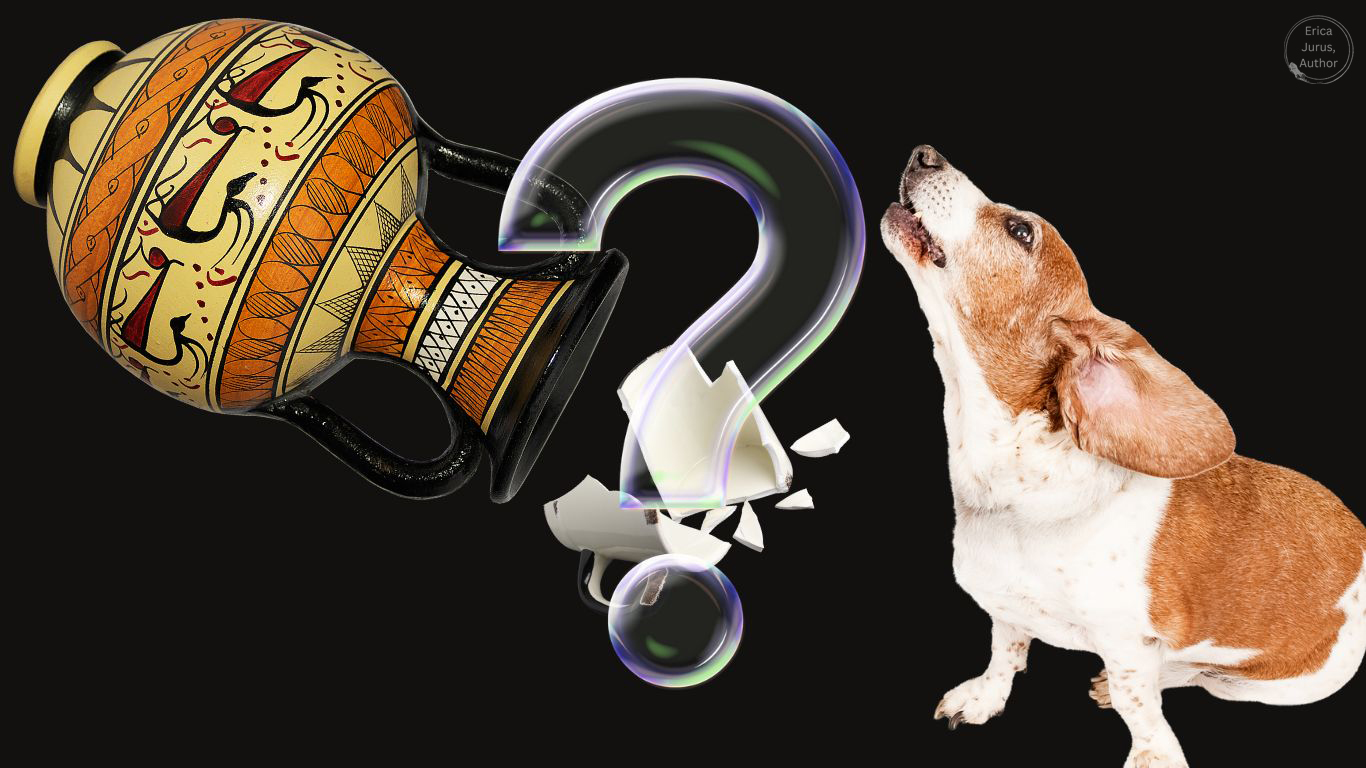
Monday’s Facebook quote may not have made a lot of sense to you initially, but it will in two shakes 😉.
Today we’re looking at idioms, which are so pervasive in our culture that we rarely think about them.
It’s hard to find an adequate definition of “idiom”. The worst I came across was “a group of words established by usage as having a meaning not deducible from those of the individual words”. We might have to beat our brains out to make sense of that one – it’s a good thing examples were provided (“e.g., rain cats and dogs, see the light”).
The way I’d define it is a phrase we all understand to represent, and usually, emphasize, an idea – even if the phrase itself doesn’t make literal sense. We know that it never does actually rain cats and dogs, but for some reason we understand that it means raining heavily.
According to the U.S. Library of Congress, the origin of the idiom is unknown. However, some possibilities are:
- Odin, the Norse god of storms, was often pictured with dogs and wolves, which were symbols of wind. Witches, who supposedly rode their brooms during storms, were often pictured with black cats, which became signs of heavy rain for sailors. Therefore, “raining cats and dogs” may refer to a storm with wind (dogs) and heavy rain (cats).
- “Cats and dogs” may come from the Greek expression cata doxa, which means “contrary to experience or belief.” If it is raining cats and dogs, it is raining unusually or unbelievably hard.
- “Cats and dogs” may be a perversion of the now obsolete word catadupe. In old English, catadupe meant a cataract or waterfall. A version of catadupe existed in many old languages. In Latin, for example, catadupa was borrowed from the classical Greek κατάδουποι, which referred to the cataracts of the Nile River. So, to say it’s raining “cats and dogs” might be to say it’s raining waterfalls.
The second theory sounds pretty reasonable to me; we certainly have drawn many words from Greek into English, so why not a few phrases?
Quite a few idioms do make a certain amount of sense. Take “calling it a day”, which means to stop working on something, usually the work day itself. An alternative version is to “pack it in”, which apparently “alludes to packing one’s things before departing, and during World War I became military slang for being killed” (Dictionary.com).
On the other hand, we all say we’re feeling “under the weather” from time to time, but where did that come from? It’s believed to have a nautical origin: when sailors were feeling sick they’d go below decks out of the bad weather that was making them feel bad, to literally ‘under the weather’.
If we “spill the beans”, we’ve blabbed about something we shouldn’t have. The best guess for that idiom’s origin ties into a method of voting in ancient Greece by placing either of two differently-coloured beans into a vase; a white bean represented yes, while a dark bean meant no. If someone knocked the jar over, the secret outcome would have been revealed.
This entire post was inspired by one of Gary Larson’s The Far Side cartoons, in which he often lampooned concepts we take for granted, like this one:

I love the expression on the bull in the foreground, with his shifty eyes – he’s clearly up to some mischief.
A bull in a china shop, a metaphor for someone very clumsy (and perhaps liable to break things), has murky origins as well. All that’s known is that it first made an appearance in a novel by Frederick Marryat, Jacob Faithful (1834).
But watch what happens when the Mythbusters tested the idiom out, by setting up a representative ‘china shop’ in a corral, then letting first one, then more bulls loose in it.

Idiom busted! A better expression might be ‘like a china cabinet in an earthquake’. I can offer this with some authority, having watched our friends in California, as soon as an earthquake hit, rush to hold up the china cabinet in the dining room so that it wouldn’t topple over. We were freaked, they were protecting the china. Apparently we were replaceable 😉. My suggestion doesn’t really apply to a person, though, just a pottery-threatening event. Ah well, better luck next time.
Writers often use idioms because they’re so relatable to our readers, but poking fun at these turns of phrase sometimes is good too.