Did you know that there’s a tree on the Earth that’s as old as the Pyramids? It’s a Bristlecone Pine in the White Mountains of eastern California that’s over 4,500 years old, and its name is “Methuselah”. The location of this venerable old tree is secret, to keep it safe from frickin’ idiots who’d either carve their names on it, or take its cones, or even benevolent photographers who could damage the fragile soil it grows in.
The Dawn Redwood species of tree, shown in the photo below, dates back about 150 million years. It was known in the fossil record before it was found alive on the planet. It’s a beautiful tree, with richly textured bark and remarkably soft, feathery needle-leaves. It’s now endangered.

One of the iconic trees in Africa, the Baobab, looks like it’s upside-down in the soil, like its roots are waving in the air. This tree grows in arid landscapes, which are common in the southern part of the continent. Remarkably, it can store up to 120,000 litres of water in its tree trunk.

Everyone loves bananas. (Fine, there might be a few curmudgeons that don’t, but that’s their loss 😉). It turns out that these funky-looking fruit contain a natural chemical that makes people feel happy. To broaden their appeal, they’re so versatile – banana bread, sauteed bananas, banana pudding… Years ago at a destination wedding in Jamaica, I was in line in the resort’s lunch buffet, which featured a huge pan of bananas sauteed in butter and brown sugar. When I casually suggested to a friend behind me that I thought those lushly caramelized bananas would be delightful on top of some vanilla ice cream, he accused me of being the devil, for what I guess was enormous dessert temptation. Such is the power of the fruit trees give us.

The more urbanized we become, the more we tend to brush off the green in our lives as mere decoration – a few trees in planters along the streets, a few flowers that announce the entrance to a mall, grass that always needs cutting.
But if you, like me, love the aroma of freshly-cut grass, if it always makes you think of summertime and picnics, there’s a reason: the chemicals released from the cuttings relieve stress. They’re called green leaf volatiles, and researchers have found they can help to lower your blood pressure and heart rate, and reduce feelings of anxiety and fear.
The plants we often take for granted support all ecosystems on Earth. They support us. They bring enormous enrichment to our lives. They bring life.

There are approximately 400,000 known plant species in the world, and it’s estimated that around 2,000 new plant species are discovered every year. Around 30,000 of those species are used in medicines that keep us alive and functional.
But we’re losing them rapidly. Over 570 plant species have ceased to exist since 1750 – twice the recorded number of bird, mammal and amphibian extinctions combined.

The colour green itself has a considerable effect on our well-being. Our eyes are especially sensitive to it because it falls in the middle of the visible spectrum, which makes easy to look at as well as calming to the mind. Its connection to plants and growth also symbolizes life, and renewal, to us.

Research has shown that exposure to green spaces, whether in forests or parks in our cities, can reduce stress levels, increase relaxation and improve our mood, and that people working in green environments are less fatigued, more focused and even more innovative.
In the dreary northern winter months, when we don’t get a lot of good-quality daylight, green environments can help with the effects of Seasonal Affective Disorder. During some of our worst, or longest winters that I can recall, I’ve spent some time hanging out at one of our local greenhouses to get a much-needed infusion of spring. You’ll often find me out at our botanic garden in March looking for fresh shoots of spring flowers bursting out among the drab landscape.
On the flip side, scientific evidence suggests that alienation from nature, called nature-deficit disorder’, contributes to a host of problems in both children and adults, including attention difficulties, emotional imbalance, and increased rates of obesity and physical illness.
And it’s not just the greenery that we love about being outdoors – it’s the animals that inhabit it. Studies have also shown that listening to birdsong decreases paranoia and anxiety (I love hearing the first spring bursts of song), and doctors in a number of countries have experimented with issuing “green prescriptions,” i.e. having patients spend more time outdoors. The results from this innovative (at least in modern eyes) therapy has shown positive mental and cardiovascular health benefits.

Of course, Indigenous peoples have understood this for a long time, as have the Japanese, who’ve been advocating ‘forest bathing’ for decades. Forest Bathing encourages people to engage all their senses, making a deep and mindful connection with the natural world.
I’ve blogged about some of this before, but with all the environmental anxiety around, it seemed to be a great time to point out our rather complacent, even dismissive, attitude to the stunningly gorgeous Green Dimension we still have access to, and are completely dependent on.
We get 60% of our energy intake from just three plant species: wheat, rice and maize. This is a dangerous position to be in, should a pest or disease wipe one or more of those out. In our modern time, two in every five wild plant species are threatened with extinction, reducing possible alternatives for our food supply.

Plants are rather brilliant beings, despite looking like they’re just standing around in the sun. For one thing, they ‘talk’ to each other – through their roots, using chemicals called ‘root exudates’ that inform neighbours in the same root zone how they’re doing. They can even share carbon with each other in the same way. They react to sound, such as music, and can sense the vibrations of water flowing underground to locate a water source.
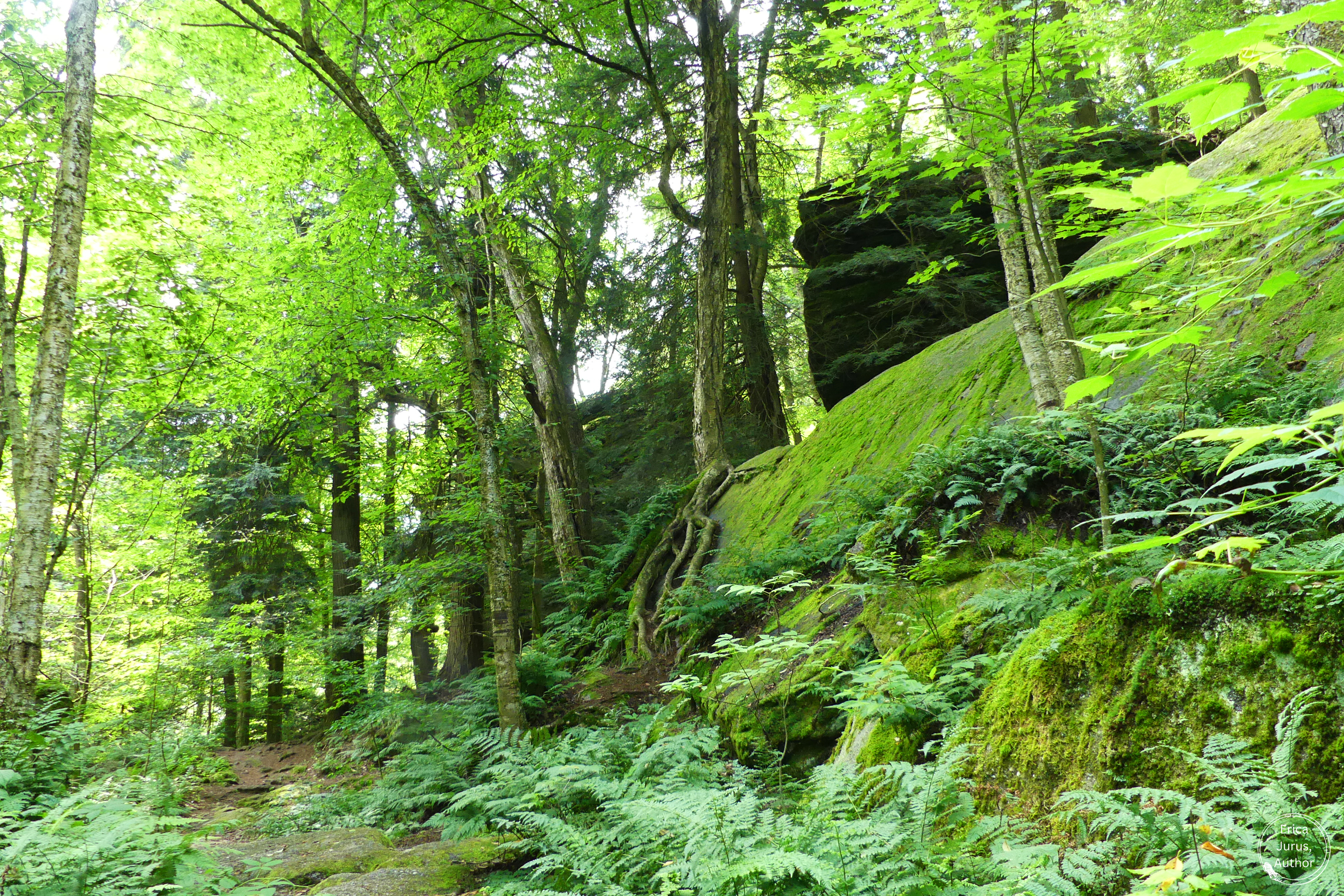
Cells in plants’ roots and stems can detect the pull of gravity on their bodies – when a plant is tilted (as when they grow on a hillside, or out of the side of a wall or a cliff face), grains of starch within them shift around to tell the plant which way is up. When a plant is tilted, these starch grains shift from side to side, which stimulates hormones that tell the plant which way is up. The plants will make adjustments by elongating the cells on one side and shortening those on the other.
Plants and their lore are losing ground in our consciousness because we see ourselves as so separate from them. We even forget that without them we’d have no pollinators, no food, no shelter, no air to breathe – no life. I feel that’s why gardens, and in particular botanic gardens, are so important. I’ve learned so much just by exploring the several botanic gardens I’m so lucky to live in proximity to; the more I spend time photographing the plants, the more I’ve come to learn about and realize how special they all are, and what a treasure we have on our hands that we must not let go of.

Many people, myself included, believe in The Gaia hypothesis, which holds that our planet is a complex, self-regulating system, perhaps even an organism in its own right – one which works hard, just like our own bodies, to maintain conditions for life to continue.
The Gaia hypothesis was co-developed in the 1970s by a chemist named James Lovelock and a microbiologist named Lynn Margulis. Lovelock’s neighbour, novelist William Golding (Lord of the Flies), suggested that he name it after Gaia, the primordial deity who in Greek mythology personified the planet.
While working with the US space program, Lovelock had been developing ways for determining whether a planet could support life. He noted that living organisms naturally changed a planet’s atmosphere, and also how humanity was already dangerously changing Earth’s atmosphere.
Lovelock and Margulis proposed in their paper (Atmospheric homeostasis by and for the biosphere: The Gaia hypothesis) that “early after life began it acquired control of the planetary environment and that this homeostasis by and for the biosphere has persisted ever since.” Critics objected to the idea that life “manages” its environment, but I for one agree with it. We have only to look at how beautifully ecosystems run, from the tiniest to the largest, if humans aren’t interfering; look how many recovered during the Covid lock-downs (for example, reduced water pollution led to dolphins returning to many areas they’d stayed away from for more than a decade).
I think a lot about planets and ecosystems as I’m writing my novels, where the environment is deeply entwined with every setting, so along with just liking to breathe, I place a fair amount of importance on how plants and animals interact with each other.

So what do we humans, ‘caretakers’ of the planet, do about this? Well, ‘Rewilding’ is increasing: the large-scale restoration of natural environments to increase biodiversity and reestablish viable ecosystems for wildlife.
If you’re a gardener on any scale, plant flowers and shrubs that provide nectar for bees, the single most critical pollinator on the planet. If I, who have zero talent for growing things, can have all kinds of bees buzzing around, anyone can do it.

I was inspired to write this post by a particular article I read on the subject, Seeing Green: Why We Should All Be Paying Attention to Plants, by Klaudia Khan: “Looking at plants and seeing them for what they truly are is like stepping into another realm or expanding our universe into another dimension: the green dimension.” I love that term, green dimension.
Given our modern state of ‘plant blindness’, we can work on realizing how important the Green Dimension really is. We need to truly love our plants, from the smallest and humblest to the most beautiful and majestic. We can spread awareness, help others to understand.
To that end, I’ve added a new page to my website called Green Dimension Photography (with all due respect and thanks to Klaudia for inspiring the name) to showcase the beauty all around us, if we just look for it, and I’m supporting an organization called Planet Wild who I believe does great work in ecosystem restoration. Once I get everything hooked up with my Fine Art America account, some of the photographs will be available to buy and hang in your own home, and all proceeds from those sales will go directly to Planet Wild.
If you’re interested in learning more about rewilding and our deep relationship with nature, you may want to check out the books by Vanessa Chakour, an author, nature advocate and rewilding facilitator, including Awakening Artemis: Deepening Intimacy with the Living Earth and Reclaiming our Wild Nature (2021) and Earthly Bodies: Embracing Animal Nature (coming September, 2024).
I hope my photographs give you a sense of both peace and wonder, and that they inspire you to spend more time in nature yourself. It’s all around us, but maybe not for long if we’re not careful. And please do feel free to comment either on this article or the photos, or both.
