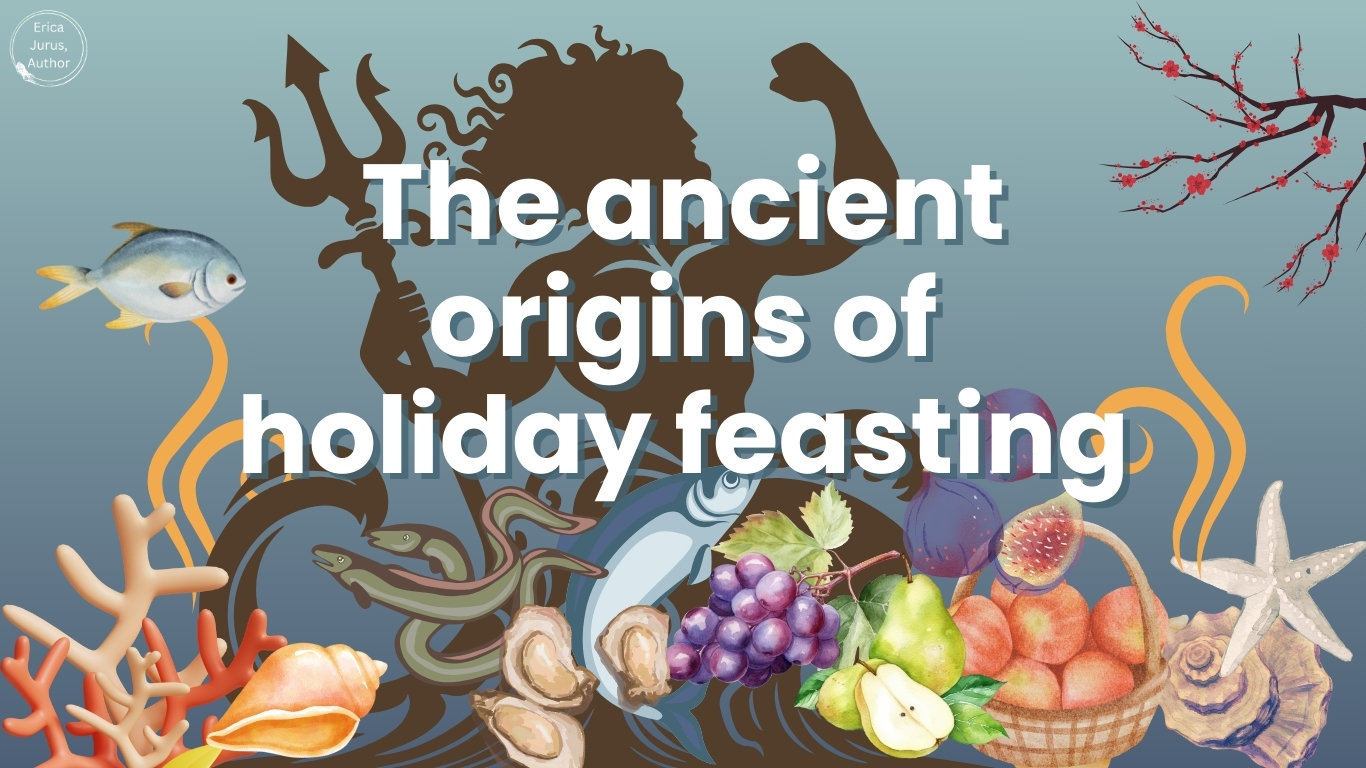
I begin to sing about Poseidon, the great god,
mover of the earth and fruitless sea
god of the deep who is also lord of Helicon and wide Aegae.
A two-fold office the gods allotted you,
O Shaker of the Earth, to be a tamer of horses
and a saviour of ships!
Hail, Poseidon, Holder of the Earth, dark-haired lord!
O blessed one, be kindly in heart
and help those who voyage in ships!
(Homeric Hymn to Poseidon)
If you’ve ever worried about your holiday merriment becoming a little excessive, I can reassure you – you have nothing on the ancient Greeks.
The Greeks lived in a world dominated by a large number of goddesses and gods, and devoted a lot of time to propitiating their temperamental and jealous overlords. They held all kinds of festivals to demonstrate their devotion, but these events also brought communities together – and allowed the people to have some fun in between sweating what the gods were going to strike them down with next.
Each month of the ancient Athenian calendar was named after a different god or goddess, with corresponding festivals to celebrate. July was the first month of the New Year. The sixth month, then, roughly equivalent to our modern December, was centred around the winter solstice, and was dedicated to the god Poseidon, one of the Big Twelve on Mount Olympus.

Poseidon was a powerful deity. After his father Cronus, the leader of the primordial Titans, was overthrown, the world was divided into three territories. Zeus was given the sky, and basically became the head of the new pantheon. Hades was given the not-so-enviable Underworld segment, while Poseidon ruled the sea.
Despite his dominion of cold and stormy waters, Poseidon was a hot-blooded god; he apparently had many lovers both male and female (not all of whom were exactly willing). This led to his siring many heroes, including Theseus, who famously slew the terrible Minotaur.
One of his liaisons that has interested me the most was with a mortal woman named Cleito. He fell in love with her and created a sanctuary at the top of a hill near the middle of the island she lived on. In order to ‘protect’ her (jealous much?), he surrounded the dwelling with rings of water and land. She ended up giving birth to five sets of twin boys, the firstborn of whom was named Atlas. He became the first ruler of the civilization that would be known as Atlantis.

The ancient Greeks honoured the god each December with the Poseidonia festival, held predominantly in coastal regions, where the communities were dependent on fishing and trade. Celebrants petitioned for safety on the seas, and if you’re honouring a god with a healthy interest in sex, what else do you do but include wild celebrations and drunken debauchery?
One of these celebrations was the Haloa, a women-only shindig involving nakedness, a lot of wine and “erotic cakes”. The festival was sacred to Demeter, the goddess of agriculture and the harvest, i.e. fertility. Men were almost always excluded from taking part, but, as head of the household, they had a legal and moral obligation to pay for their wives’ expenses to attend the festivities. Good deal for the women!
The Haloa apparently included a mysterious ritual to invoke Demeter and ensure the fertility of the land. There was a feast, with little or no meat but plenty of fish, fruit (except pomegranates, which drew Demeter’s daughter, Persephone, back to the Underworld for six months of each year), cereals, and those explicitly-shaped cakes. A group of men called ‘Arkhontes’, who served as authorities of the mysteries, prepared the banquet.
In the meantime, the men got a huge bonfire going, carrying on a regular tradition of fire lighting. The following day, the communal celebration resumed with public banquets, animal sacrifices and more sex.There was much giving of gifts as well. The month of Poseidon was the most looked-forward-to time of the entire year in ancient Greece.
So as our winter solstice draws near, remember that it’s always been a time to celebrate the bounty of the earth, and however you choose to keep it stays between you and your guests😉