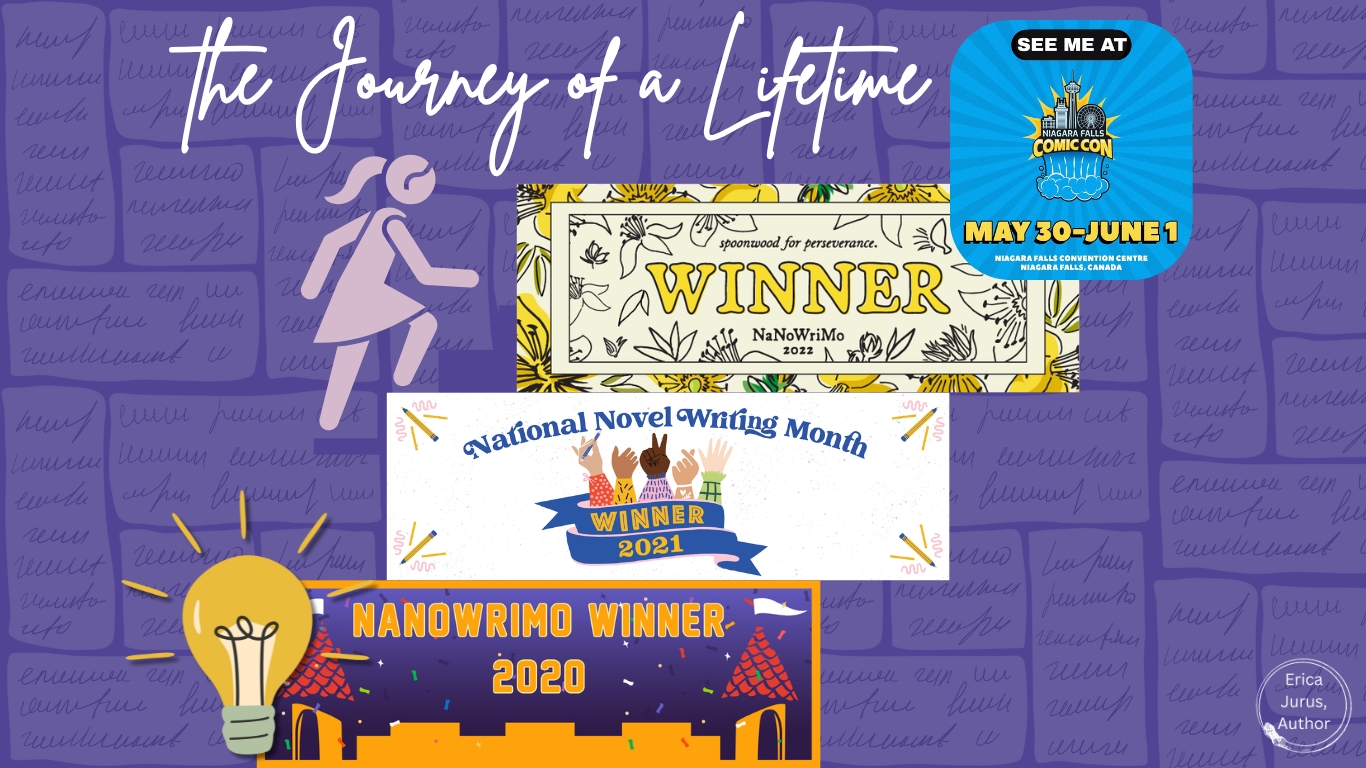
As I’m finishing the final edit of my third novel, the book that wraps up the epic story I began scribing five years ago, I’ve been saddened to hear that NaNoWriMo, the nickname of the National Novel Writing Month organization, is closing its virtual doors.
The nonprofit, founded in 1999 to give aspiring writers the support to try putting together our first novel, has been plagued by issues over the past couple of years.
The idea of National Novel Writing Month was to try and write 50,000 words in 30 days. No editing, no pressure to make it perfect, just to get that story out of your head and onto ‘paper’, where you could then do something with it.
I’d dabbled with the annual November writing sprint earlier, but was still working full time and just couldn’t get into it.
By 2020, however, I’d retired, coincidentally just as the COVID juggernaut rolled across our planet and we all became more-or-less trapped in our homes. My hubby was an essential worker, so he was still getting out of the house several days a week, but my nascent retirement plans to pop in and visit my coworkers and/or go out for coffee from time to time had all gone up in smoke. I had nothing to do, other than wait in long lines to get into a grocery store.
We bought a bread machine and I baked a lot of different loaves, so that was fun. I baked sweets regularly for Afternoon Tea when my hubby got home from work every day, a little treat in the messed-up scenario we were all living. We started putting on weight, so that had to moderated a bit.
In the summer months I began visiting our local botanical garden, where I could walk around in the fresh, breezy air without a mask, letting Nature take some of the edge off my cabin fever, and even chatting (at a safe distance) with the handful of other visitors who were eager for any kind of new conversation.
But my thoughts kept returning to three books I’d always wanted to write – a memoir of our crazy travels together (much requested by family and friends), a self-help book about growing through getting outside your comfort zone, and this kind-of-epic urban fantasy/sci-fi story that had been living in my head for a while, unformed but persistent.
Despite the outlines I had for the two non-fiction books, that darned fiction book was just bugging the hell out of me. It wanted to come out, no matter how much I told it that a non-fiction book would be faster to write, and probably more lucrative.
And so, I decided to join NaNoWriMo in earnest that fall. I told my hubby that I wanted to give it a shot, and that I’d be tied up writing for a good part of each day. He didn’t poo-poo the idea, even though I had absolutely no idea if I could do it. But one of my maxims has always been ‘you’ll never know unless you try’.
Participating in NaNoWriMo was really exciting. There were Discord discussion groups you could join to share the journey with people writing in your own genre, or any other kind of common bond you might imagine. You logged your progress on the NaNoWriMo website every day – at least I did – and it gave you little achievement badges.

I calculated that to make the 50,000-word goal I’d have to write at least 1,600 words a day and I persevered, sometimes writing more, sometimes less. I had a rough outline going into the event: I knew where the story was going to begin and to end, and I’d always known that it would become a trilogy. Those were my signposts along the way if I felt I was getting lost or overwhelmed.
And I won’t lie, it was a grind. But, to my enormous surprise, I flat-out loved it! Once I got began telling the story of Romy Ussher and the insane supernatural world she was unwillingly dragged into, the whole thing truly took on a life of its own and I was along for the ride.
By November 30 I’d crossed the finish line. I’d written 50,520 words, and I had the makings of an entire novel. I kept going, taking a break through December for the holidays. Romy and the other characters began surprising me, and the story I’d worried about being able to fill a book with grew to fill the trilogy I’d planned. I got Romy to the dreadful, cliffhanger ending of book 1 on July 31st, 2021, and with trembling fingers typed “The End”.
Holy shit, I’d written a book. I’d bought a bottle of our favourite champagne beforehand just in case, and the next day my hubby and I cracked it open with some family members to celebrate.
After letting the book rest for a bit, I edited it, recruited a group of beta readers to see if it was anything worth reading, and that November started into book 2. In November 2022 I embarked on the mammoth task of book 3, the grand finale, having earned some passionate fans of the first two novels. Next month I’ll be launching book 3, Out of Time, in style at Niagara Falls Comic Con, hoping to entice some of the 30,000+ visitors to my booth to have a look.
NaNoWriMo shepherded me through this entire wonderful, bucket-list journey. It was my safe space to try out my ideas among thousands of other writers just like me. Some famous novels have come out of that event, including The Night Circus, by Erin Morgenstern, and Water for Elephants, by Sarah Gruen. For three years I looked forward to November.
However, In November 2023 I received an email from my Municipal Liaison (ML) that there were some ongoing concerns about forum moderation.

Each region had an ML to oversee and moderate chats among participants. Before COVID, write-ins were often held in person, at local cafes or other spots where we could gather and do writing sprints. Everything became virtual in 2020, which is the year I seriously embarked on my journey.
Our ML was great, and in the discussion boards I saw her handle unruly participants with grace and aplomb. But as you might imagine, with over 400K people joining each year (amongst the various programs running throughout the 12 calendar months), it had to be a challenge keeping everyone polite.
According to our ML, there hadn’t been any issues locally, but on the global stage, the words “lawyers and law enforcement” came up. The MLs didn’t know what was going on at that point, but many of the regional forums shut down.
Far beyond cranky participants, it turns out that at least one ML was grooming, in the worst sense of the word, young participants in one of the Young Writers Program forums. It’s heartbreaking that someone chose to take advantage of such a great program.
Then apparently there were financial issues, which the nonprofit has cited as the main reason for shutting things down.
But there was also what I call AI-Gate. When AI tools began to proliferate, NaNoWriMo’s stance was that “to categorically condemn AI would be to ignore classist and ableist issues surrounding the use of the technology, and that questions around the use of AI tie to questions around privilege.” Well, that put up the backs of thousands of writers who feel that we are creators, from all walks of life, and proud of our work.
The New Yorker published an essay by Ted Chiang called AI Isn’t Going To Make Art, in which he wrote “What I’m saying is that art requires making choices at every scale; the countless small-scale choices made during implementation are just as important to the final product as the few large-scale choices made during the conception… Generative A.I. appeals to people who think they can express themselves in a medium without actually working in that medium.”
A fellow in one of my Facebook author groups actually asked if he could call himself the author of a book written for him by an AI program! Hard no.
Now, hiring an editor is a very expensive proposition. They charge by the word, so to have run my roughly 190K-word first book past an editor would have cost me in the neighbourhood of $4,000, which I didn’t have. I’m very lucky that I learned structure, grammar and proofreading early on in school, and have done it professionally at times in my varied careers, along with writing articles and media copy. Not everyone had/has that advantage.
BUT, I think the process of learning those skills is critical. Published writers always advise aspiring writers to read a lot of good writing, anything from novels to great pieces of journalism. Learning how to articulate your ideas well enough to bring them to life for readers is essential to becoming a good writer. And there are plenty of courses available.
Needless to say, a lot of passionate writers were really taken aback by NaNoWriMo’s position, and began to pull away. It turned out to be a serious misstep on NaNo’s part.
And so, tragically (and I do mean that very word), a great writing initiative is slipping away. I can’t tell you how many aspiring writers I’ve recommended it to since I first set foot in its waters – some just a couple of months ago. I’m sad that they’ll now never be able to experience the camaraderie and rush of NaNo Novembers, and the feeling of accomplishment. I tip my hat to the original organizers for taking a tiny idea and turning it into something truly wonderful, with my personal thanks for giving me the opportunity to become an author.