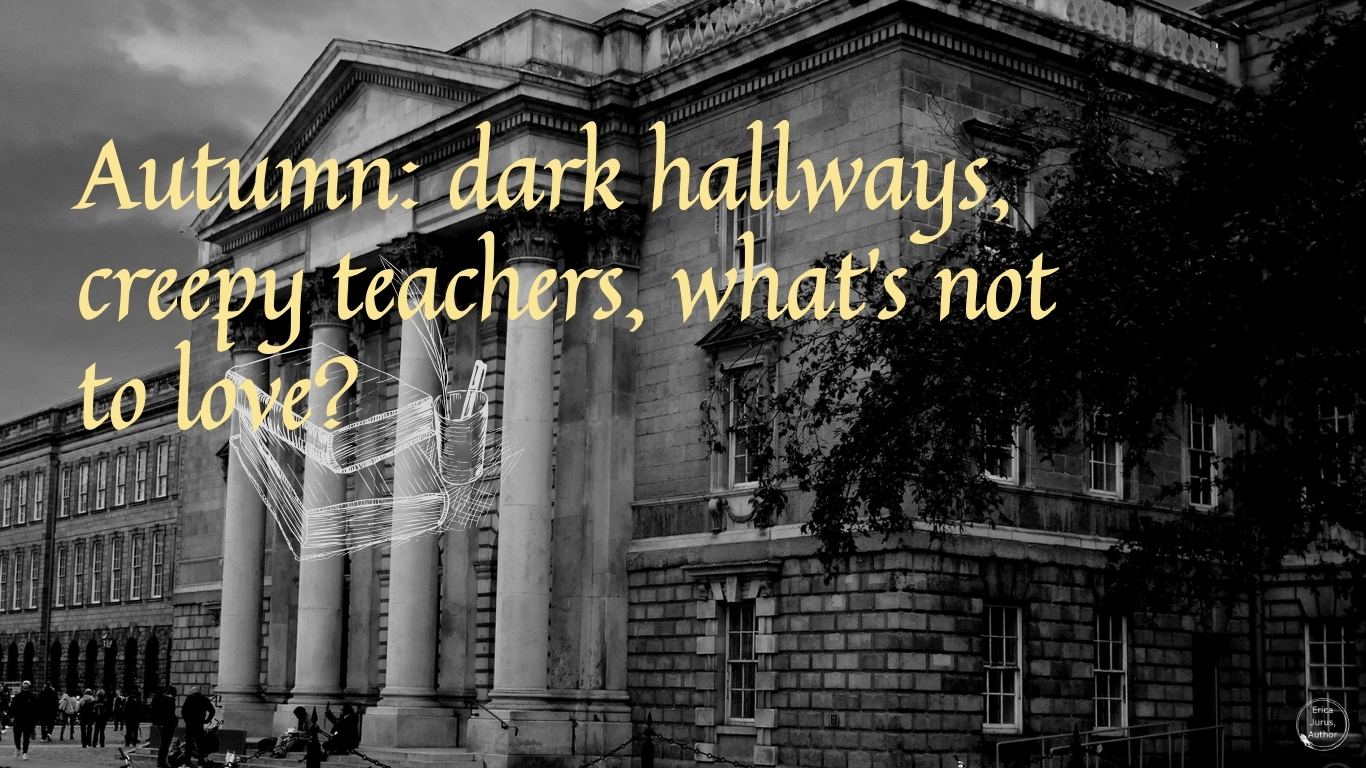
If you attended a school where an atrocious murder was committed, or where something dark and unnatural crept the hallways, would you be fascinated, or horrified?
I’m one of the few people I know who loved school, loved the entire back-to-school August prep. So why are so many people drawn to the ambience of Dark Academia? Is it a desire for the kind of school they’d prefer to have attended? Is it belated wish-fulfillment, that schools might go up in dark flames in some fanciful fashion?
There’s something about the cloistered atmosphere of a school, where hundreds or thousands of staff and students are thrown together whether they want to be or not, with all the power dynamics that develop, that makes it fertile ground for bad things to explode against the perfect backdrop of a regimented, rules-bound institution.
The schools I attended were completely tame, although some of the few nuns were a bit grumpy. One Sister really didn’t like male students – not sure what was in her past, nor would I have wanted to find out at that age. By high school I was leaning slightly goth in my tastes, long before it became an aesthetic, so a surprising number of people thought I was a witch (limited imagination on their part).
But other than the usual teenage turmoil, nothing untoward went on, much as I might have liked it to.
What is “dark academia”, really? All the books I’ve read that embrace the culture feature either heinous crime or the supernatural, or both. The aesthetic, however, judging by images on Pinterest, is all about gorgeously gothic libraries, shadowy stone architecture, and preppy clothing in morose tones.

It’s been criticized for colonialist overtones and the kind of education that only wealthy whites could afford, and many of the books out there do contain that assumed privilege. My favourites, though, revolve more around the supernatural than the elitism. There are often groups inside the fictional school made up of ‘those’ people – the ones who believe they’re above everyone else. I’m thinking of the Harry Potter books, where Draco Malfoy and his cronies despise the students, like Hermione Granger, who have non-magical parents – given the odious slur of “mudbloods”.
Hermione shows that she’s more than a match for Draco, and a better wizard to boot. And yet, we might wonder how much growth Draco might have shown with different parents, something that J. K. Rowling didn’t explore.
Anyway, the aspects of my kind of dark academia that attract me are the mysteries within the shadowed halls. Ghosts, murky histories, ancient secrets, hidden knowledge in forbidden tomes, power struggles (student vs student, student vs staff, students vs monsters internal or external). I could have wished to spend several years at a university like that, where attending classes or walking the halls might have had the flavour of an Edgar Allan Poe story.

Many of the tropes of dark academia to my mind are really adaptable to that imaginary Poe-themed college:
- Cool fall weather: this is a given to me, as the chill, mists and thick dark clouds just enhance the feeling of strangeness.
- Gothic architecture. Gargoyles are a natural for a darkened ambience, brooding from their rooftop perches over the people bustling along sidewalks below.
- I suppose the idea of snotty students studying the classics was designed to emphasize their inflated self-opinions. I studied a few such courses myself as part of what my university considered a way to round out my science major, and because they interested me – but to my mind, a great story would feature some really interesting character development through all kinds of different subjects. (And by the way, my studies in classical mythology led to some of the most memorable characters in my Chaos Roads trilogy.)
- The characters are usually brilliant and eccentric. Well, I don’t think brilliance necessarily equates with elitism – there are plenty of brilliant students from lower-income families. Brilliant villains are often the most interesting, though, because you wait to see what nastiness they’ve dreamed up, and how well they’re going to disguise it until the big reveal. And brilliant villains need an equal heroine/hero to battle them – Moriarty vs Sherlock Holmes.
- Expensive vices, such as smoking cigars or indulging in favourite tipples, might define some of the students and/or staff. There have been criticisms of the ‘glamourization’ of these kinds of behaviours. The truth is that students, let loose from home, often bust out and over-embrace their parentless freedom. In Donna Tartt’s novel The Secret History, the protagonist gets entangled with a group of students that he glamourizes in his own mind – wealthy-cool, part of a special study group, and encouraged by their prof to think beyond societal norms. In his place, I would have thought they were twits, but that wouldn’t have made a very good story, unless I somehow got dragged into their shenanigans against my will – which could have worked well instead. Writers choose certain permutations that work for the story they want to tell, and hopefully our readers enjoy them.
- Murder often stalks the halls of dark academia, because clearly something nefarious is going to happen. Within the dark fantasy or horror genres, the murders can be very creative indeed. Imagine an Agatha Christie scenario transposed to someplace supernatural – how fun would that be?! (Great idea for another book! 😉)
For my novels, I really enjoyed mapping out a college outside the Ontario government system, that was steeped in the uncanniness created by three converging ley lines and attracted students who might learn how to deal with other layers of reality. The entire campus was filled with eccentricities, and cozy pubs with great food to offset the deepest shadows.

After high school, I treasured my days at my perfectly ordinary university and learning all about science and mythology, but I would have really loved studying at Tempus College, where those two aspects not only met, but intertwined in strange and mysterious ways. Dark academia, if it’s done well, allows us our nostalgia while we step into an alternate, darker life for a while.
One of my favourite books, classified as a retelling of an old fairy tale, for me falls perfectly within the Dark Academia genre. In Tam Lin, by Pamela Dean, ancient powers stalk a 1970s campus, and the heroine must save her love from a darkly elite fellowship of students snared by a Fae. The university world is both typical and twisted, and the mystery deepens in a deliciously slow-cooked way. A great read as our days cool off, chill winds blow, early leaves swirl down and schools once again welcome learners through their doors, while I get busy mapping out the great idea I had above.
(All images are by me and may not be reproduced without my express permission. E. Jurus)