“She finds out that a lot of our Earth history isn’t necessarily what we have been led to believe.” Author
How do you talk about yourself?
When I was invited to be on a podcast featuring indie authors recently, the first thing I did was research into how not to be a dud.
I’m fine with speaking – when I was part of Toastmasters, the organization that teaches you how to be a public speaker, I did a lot of it. But being interviewed for 45 minutes, on air, is a different beast.
Recommendation 1: get a stand-alone microphone and headphones. I had a set of headphones, but they recently bit the dust, so I bought a nice pro-looking new set, and a chic black mic – not top of the line (there may be an upgrade if I start doing a lot of these), but well-rated and easy to set up. Perfect for a beginner.
2. Find a room with good acoustics to set up in. Some people do it in a closet to muffle external noise, but I don’t have one I could comfortably fit into without looking like someone in a creepy movie, or having to be removed with the jaws-of-life afterward. Our dining room has a variety of textures and surfaces, so I figured that was a good alternative.
3. Research the host and listen to a few of their podcasts to get a feel for their style and the kinds of questions they ask. Check.
4. Be well rested and in good shape. I had to reschedule the first date due to a brief bug with uncontrolled coughing, which I didn’t think would come across very well. My host agreed.
5. Have some notes ready for potential discussion points. Done.
I was a little nervous, generally about being an interesting guest. But, as ‘they’ say, no guts no glory. At the appointed time, I logged into Jason’s Zoom link. I’d requested having our cameras on, which I thought would make me feel more natural than responding to a disembodied voice, and Jason obliged. And then we embarked on our conversation.

After Jason’s kind introduction, he asked me to provide an overview of my three novels, of course. We discussed marketing novels that cross different genres. Mine, for example, are a blend of urban fantasy (set in the real world with strange things happening), science fiction and some Lovecraftian horror. He asked how I found reactions to mixing genres instead of presenting pure horror or fantasy, for example.
I believe people are becoming quite used to these blends. “Romantasy”, the portmanteau word that describes the intertwining of fantasy novels with a pronounced dose of romance, has exploded onto the publishing scene after the popularity of Sarah J. Maas’ A Court of Thorns and Roses debut (affectionately known by fans as ACOTAR). Urban fantasy, or versions thereof, is prevalent on television, from shows like Stranger Things to Locke and Key to Supernatural.
Sometimes these fusion genres require a bit of explanation. Jason characterizes his own novels as ‘steampunk’, although there are subgenres within that. After several live appearances, I began to designate my novels as supernatural thrillers. Thrillers are described as featuring ‘heightened feelings of suspense, excitement, and anxiety in the audience’, and mine certainly fit that bill. They’re filled with plenty of suspense and globe-trotting adventure – it’s just that the participants are not exactly human.
“The way that I write, or the cross-genre that I have, the mix, makes it accessible to a lot of people who perhaps don’t like straight science fiction or straight urban fantasy, or even straight horror. I’ve had a number of readers who, fantasy isn’t their preferred genre, but they get into the books because they recognize Toronto, and they recognize the planet as we know it, and that there might just be some stranger things in it.” Author
Jason called me a powerhouse for writing three approximately 600-page novels. How did I manage it?
Well, that wasn’t my original intention, believe me. I had the beginning and end points of each book set, and a few plot points. My job was to try to fill in the between-stuff, and once I got going, the story kinda took care of itself. Six hundred-odd pages later, book 1 reached its foregone conclusion within the larger story. Jason and I discussed some of the ins-and-outs of putting a book together – give the podcast a listen to find out our approaches, and much more that I don’t want to spoil with this blog post.
“The story began to live in my head, like a movie that I was watching play out.” Author
I think the WIP, a horror-dark romance fusion, will work as a stand-alone. I’m taking time to insert enough brief backstory to explain what new readers will need to know. Certainly reading the trilogy first would fill in all the gaps, but it won’t be necessary.
Jason mentioned that he’d be curious to see if my new novel will draw more people into the original trilogy. I replied that of course I certainly hope it does, but here are my expanded thoughts:
With many traditionally-published novels that I’ve come across, it’s often the case that a subsequent book interests a new reader enough to want to learn the full backstory. It’s happened to me more than once.
I wrote the Chaos Roads trilogy as Romy’s origin story. For fifty-one years she’s been going along as an ‘ordinary’ person, and then in the elapsed time of a charity ball finds out that she’s anything but. I really love origin stories – how does a character get embroiled in a strange new life, how do they handle it, why do they make the choices they do? I’ve enjoyed a few series that start midstream, catapulted into a world where something’s already changed in the past, like vampires having coming out of the closet and are now already mainstream in society, but I prefer discovering the ‘big bang’, as it were. One of the best things about the Twilight series, for me, was following Bella’s slow realization that she’s gotten hooked on someone not only gorgeous but dangerously supernatural as well.
By my second book, Into the Forbidden Fire, fans were asking me to keep writing more novels set in the Chaos Roads world. I hadn’t considered that, but I had many more ideas that had sprung out of bits of the story, like leaks in a garden hose, and I’d already been wondering what I was going to do after the trilogy was completed. I adore writing, you see, and by then I already couldn’t envision a time without it in my life.
Perhaps fans of ‘horroromance’ (another new portmanteau genre title) will read my next novel and be curious or passionate enough to dive into the trilogy. My novels will be cohesive – tying threads of each other together to weave a fascinating tapestry.
The landscape of self-publishing allows authors to write stories that move them, that transcend trends or traditionally-boxed plotlines, that colour outside the lines. But there’s a lot that goes into it, including promoting your own books. Jason wants to create a podcast on all the steps required to self-publish a book, which I think is a fantastic idea. Many people have memoirs or family stories they’d like to tell, for example, or their own ideas for novels, so I look forward to that subsequent podcast with lots of good information in it, and will keep you posted.
If you’re interested in learning more in the meantime, Indie Author Day is coming up this week, on November 14th. There are several virtual events going on, and you’ll find the schedule and sign-ups on the website. Local organizations can also find out how to host their own Indie Author event; perhaps I and the many other authors in my area might join forces next year to do exactly that. There was a brief burst of initiative by our local libraries last year, but it seems to have fizzled.
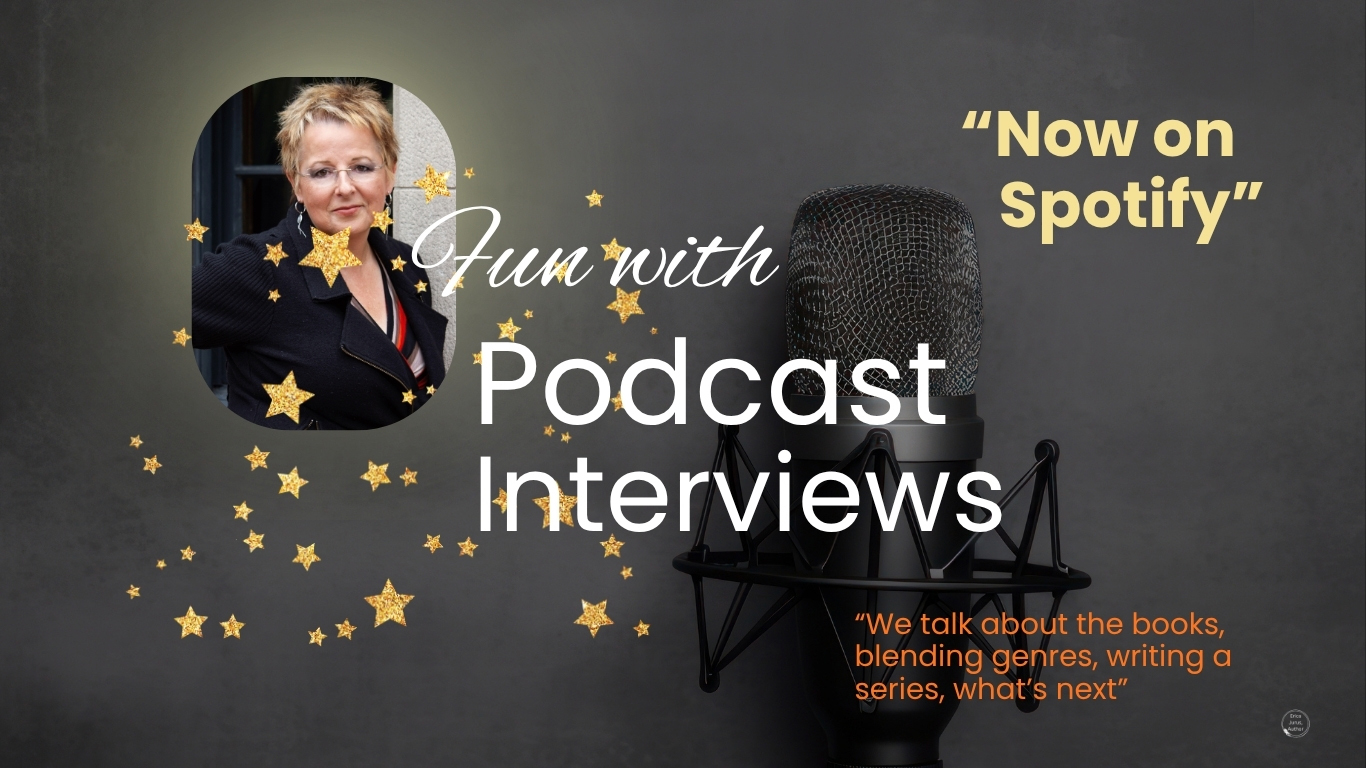
You’ll find my interview on Jason Shannon’s site on Spotify; you don’t have to sign up to listen to it. It runs for about 53 minutes, with an intro and some host-info segments interspersed. I think I did well enough for my first foray into the media form, although there a few ways I could improve in the future. I’d certainly love to hear your opinion (polite comments only, please).

Many thanks to Jason for inviting me onto his podcast – it was great fun! He’s interviewed many indie authors, and has published his own imaginative novels featuring an actual LGBT+ historical figure, the swashbuckling Olive Yang, who spurned traditional female roles in early to mid-20th century Burma to become a powerful opium warlord. Do check out his website!
Finally, I have to admit that I felt really cool sitting at my table with an official mic and very sharp-looking new headphones. For anyone who might like to feature me in a podcast, please contact me directly at roads@ericajurus.ca. I’d be happy to provide a media kit with more information and additional discussion topics.