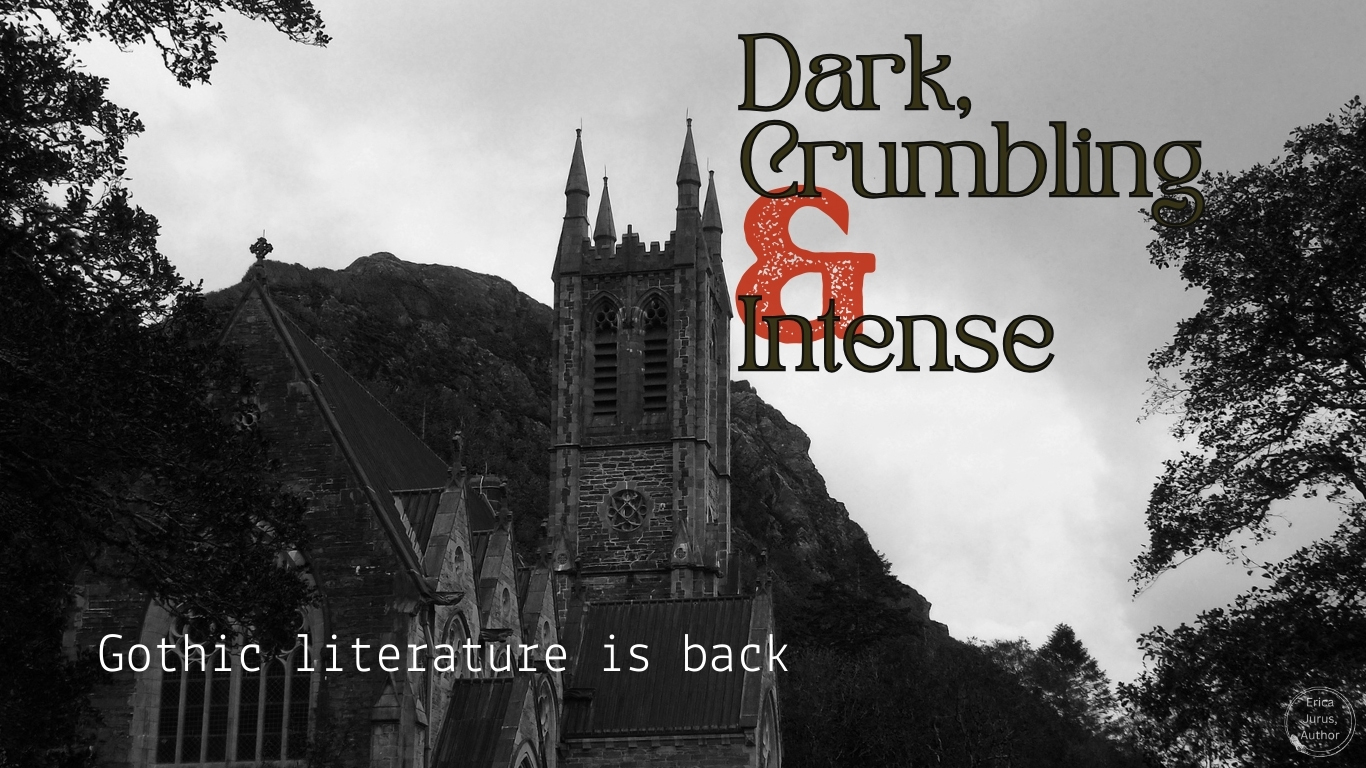
“Who shall conceive the horrors of my secret toil, as I dabbled among the unhallowed damps of the grave…” Victor Frankenstein
Another year gone – it’s hard to believe that we’re now twenty-six years past the qualms of New Year’s Eve 1999. After what I hope was a lovely holiday break for you, let’s look at a super-hot trend in literature and film as we transition to a new year: Gothic Fiction.
Oh yes – Guillermo del Toro’s Frankenstein remake (for some reason filmmakers find this story irresistible over and over again), the upcoming strangely-costumed Wuthering Heights coming out in mid-February – dark, intense melodrama is hitting it big!

Mysterious mansions with winding passageways and forbidden rooms, enigmatic/perhaps beastly owners, foreboding atmosphere, hauntings or a family curse – I was engrossed in a lot of gothic fiction when I was a teenager. I read a lot of Edgar Allan Poe, and the genre populated the majority of Hammer Films, which I’ve always been a big fan of. To this day, I love the lush landscapes and colours of those movies that create such atmosphere right from the opening scenes.
Gothic literature isn’t necessarily about ghosts and hauntings, although those are often a feature. The genre is more about the mystery, dread, even terror. There’s nothing cozy or comforting involved. The characters are not having a good time – they typically experience anxiety, guilt, and perhaps madness. The Beauty and the Beast tale is a classic gothic story that’s inspired countless retellings, of a female trapped in a dark castle with an irritable and dangerous owner.
One interesting version I read over the holidays is Alix E. Harrow’s Starling House. Set in a seedy, heavily polluted coal town in Kentucky, the heroine is a young woman named Opal, who survived a car accident that her mother didn’t. Now it’s just Opal and her ailing younger brother Jasper, struggling to survive to the point that Opal obtains the bulk of their meagre resources through theft. She’s strangely drawn to a formidably off-putting mansion on the edge of town, Starling House, and is surprised when the reclusive and irascible young owner, Arthur, offers her a job as housekeeper. Ignoring all the warnings from fellow townspeople, she accepts, both for the chance to see inside, and for the substantial pay increase that will allow her to send Jasper to college, to free him from the town’s unhealthy grip. But what most people don’t know is that the house and the town are deeply intertwined, and hold a secret far weirder than Opal ever suspects – all tied to an unsettling book written by the original owner many years before. Five stars for this one.
One book that’s listed as gothic fiction and has gotten a LOT of attention is Bunny, by Mona Awad. This is hands-down the most messed-up novel I’ve ever read, to the point where I’ve been wondering if the author was stoned when she came up with the plot. She’s a very good writer – the book just didn’t work for me, unfortunately. If you’re on Goodreads, you can check out my review there. I gave it two stars only, I’m afraid.
Mexican Gothic and Southern Gothic are two rising sub-genres. Southern Gothic capitalizes on the deceptively sleepy nature of the American South, from shady trees draped with Spanish moss to old plantations with haunting secrets. The old South is filled with superstitions, unsurprisingly given its bloody history. On a visit to New Orleans several years ago where we took a ‘Vampire, Zombie and Ghost Walk’, we learned about the notorious LaLaurie Mansion, where the mistress treated her slave to unspeakably horrific experiment, and that residents still fear vampires. Anne Rice’s now-classic Interview with the Vampire is Southern Gothic horror, filling old New Orleans with tormented blood-feeders. In the true-crime vein, Midnight in the Garden of Good and Evil also falls into the category, recounting the story of a sensational murder and series of trials in sultry Savannah, Georgia, which I blogged about in November 2024 after visiting the city.

Mexican Gothic transports readers to the even sultrier climate of Mexico, with its own dark cultural secrets. If you want to read something in this subgenre, try out the aptly-named novel Mexican Gothic, by Silvia Moreno-Garcia, in which a socialite, Noemí, is asked to rescue her cousin from a crumbling estate deep in the Mexican countryside. Noemí reluctantly takes up the task, and finds some very strange goings-on after she arrives. I’ve only read the sample, so I can’t give a rating, but the novel gets really good reviews.
Moving farther back in time, and across the pond, I was a little surprised to see the classic novel Rebecca, by Daphne du Maurier, listed in the Gothic category. But the estate of Manderley on the Cornish coast holds dark secrets behind its beautiful façade, as the protagonist, a meek companion who falls under the spell of the estate’s wealthy owner, Maxim de Winter, soon finds out. She’s never given a name, in contrast to Maxim’s late first wife, the very beautiful and sophisticated Rebecca, who still casts a spell over everything even after death. From the secrets that Max withholds from his new wife to the sinister housekeeper, Mrs. Danvers, there’s a deep sense of foreboding that takes hold as soon as Max introduces his new bride to his household and friends. It’s a great novel, although to be honest I have trouble reading it because of the easily-cowed protagonist. I know, I know – it’s in character for her, and sets up the stark contrast with the continued dominance of Max’s tempestuous first marriage. Well, I’ll let you read it and see what you think.

Of course, there’s the even more-famous Jane Eyre, by Charlotte Brontë. I think the filmed versions are great fun to watch – I’m sure everyone has their favourite Mr. Rochester, but mine is the 2006 version with Ruth Wilson and Toby Stephens, which I feel truly captures the seething chemistry between the two forbidden lovers.
In an even earlier era, the Gothic novel that inspired the name of my heroine, Romy Ussher, is The Fall of the House of Usher, by Edgar Allan Poe. Poe had a dark and twisted vision of the world, which made his stories such compelling reading. In this short story, another unnamed narrator arrives at the estate of his childhood friend, Roderick Usher, who lives there with his sister Madeline, the only remaining two family members. Roderick had written complaining of an illness and asking for his help. The house of Usher is truly a crumbling domain, with a noticeable crack extending from the roof down the front of the house, and is slowly sinking into the adjacent lake. (I mean, seriously, I want to recreate it for a Halloween party!) But more than that, not only does Madeline fall into periodic cataleptic trances, but gloomy Roderick believes that the mansion is alive and that his own fate is tied to it. I won’t reveal the rest of the plot – you can read the book, or watch the wonderfully creepy 1960 movie adaptation by Roger Corman, featuring the prince of eeriness, Vincent Price, as Roderick Usher.

Well, that’s enough to keep you busy for a while, but there’s so much more. Do a search for ‘gothic fiction’ and you’ll find a lot of recommendations. Personally, as someone who wasn’t a particular fan of all the bleak, dystopian fiction that trended in recent years, I’m very glad to see the resurgence of this lushly-imagined, old-but-new-again genre.