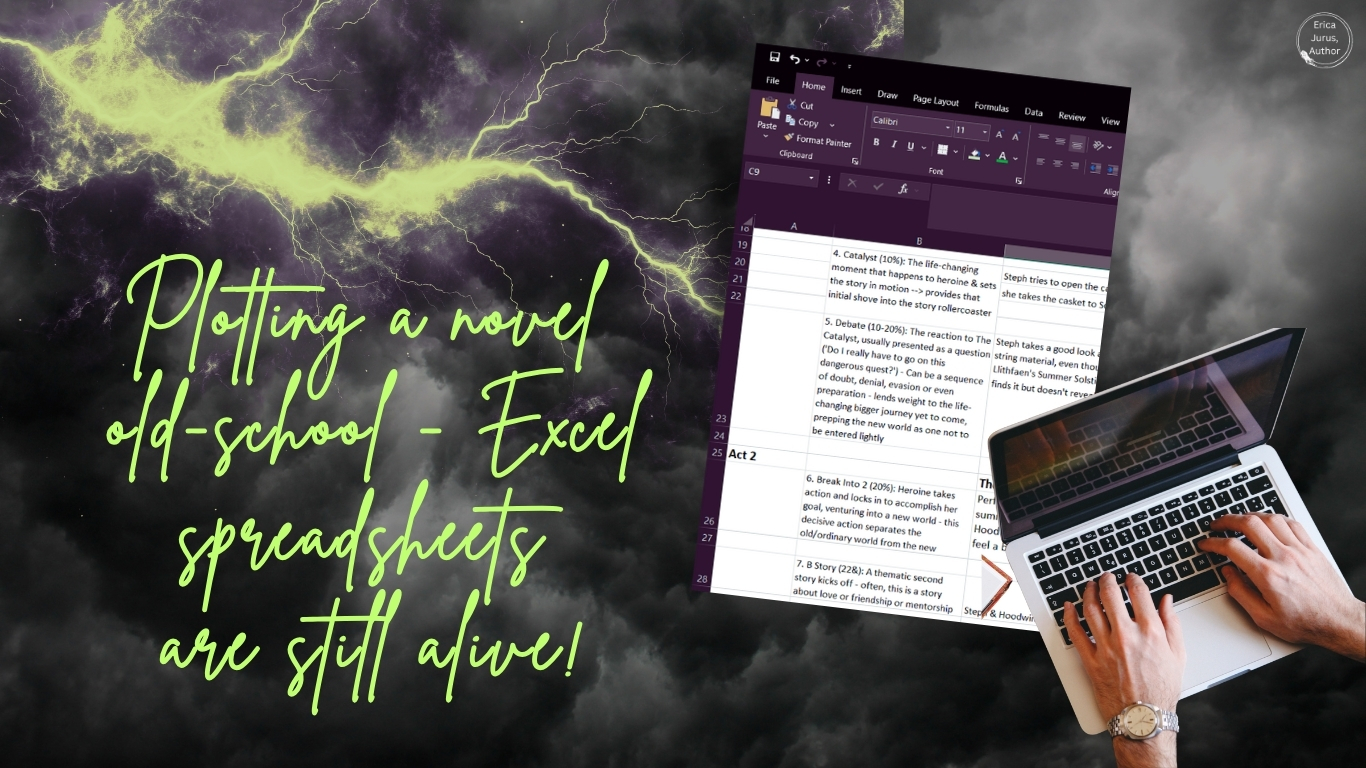
“It’s alive! It’s alive!” cries Dr. Frankenstein cries in the classic 1931 movie. I was starting to feel like his creation, plodding away with my Excel spreadsheets to plot out my novels, when I came across something that made my little old-fashioned heart beat again. Excel, the clunky, cumbersome software that apparently has become the bane of many businesses, lives on – in the form of a rousing e-sport! My choices have suddenly become relevant again!
Plotting out a novel takes some work. If you’re going to do it right, everything must progress in a logical way, even if your story isn’t told chronologically.
There are also genre-specific tropes to include – not that writers want to be predictable, but readers do expect a genre to follow certain loose rules.
In romance novels, for example, there’s typically a push-and-pull between the burgeoning lovers, with twists and turns that get in the way of what we all know is going to happen in the end. In horror novels, by contrast, there’s rarely a happy ending. Genre-blending is becoming common – there are even ‘cozy’ horror stories, where there’s little blood and gore, and people will probably live to see another day.
So, there’s obviously a beginning, and a finale, and a bunch of stuff that happens in between the two. For all three of the novels in my trilogy, I knew where each would start and wrap up. And yes, I’d always planned to conclude books 1 and 2 with cliff-hanger endings. Many readers voiced their (hopefully affectionate) frustration, but now that all three books are out, you can easily find out what happens next.
How did I make that decision? Was I just trying to hook/tease my readers? Actually, no, although that was a fun side benefit 😉 The journey of my heroine, Romy, clearly had three stages: the first terrible manifestation of her growing power, the transformation that will either help or destroy her, and whether she can then save not only Earth but the entire galaxy without losing whatever humanity she still has.
Writers make many choices – what the “inciting incident” is (the event that launches the protagonist on their journey), how much back story to include, setting the scene (each and every one) properly, when to reveal certain plot points to build suspense, what will make the most fitting ending to satisfy readers. Because it’s all about justifying our readers’ faith in picking up our book.
As you might imagine, certain genres require some tricky plotting – mysteries, and fantasy. Fantasy novels, whether urban, high fantasy, romantasy, or whatever, are usually longer books, and there’s a lot that goes into telling those stories effectively.
If they become multi-book series, the plotting becomes even more intricate, and that’s the situation I found myself in. I always knew that Romy’s story would be told in a trilogy, but as I wrote the first novel, Through the Monster-glass, and the novel grew longer and longer as the plot took shape, I became very aware of what I’d gotten myself into.
I have MS Word files on all my characters – what they look like, where they live, their back story (why and how they became the person they are when you, the reader, first meet them).
All of the buildings have pictorial files, so that I can refer to them consistently.
I drew detailed maps of the weird little town of Llithfaen, where much of the action in the trilogy takes place, and of the Tempus College campus, in MS PowerPoint.
And Excel spreadsheets became my bosom buddies for making notes about every chapter in each novel, including date, location and characters. I added extra sheets in the file for things that had to carry through to the next two books – plot points that had to be continued or resolved, questions that had to be answered (or perhaps not), ideas I wanted to follow up on, names for new characters, etc.
When laying out a novel, writers tend to generally fall into one of three types: the meticulous plotters, who work out every detail before setting finger to keyboard; the happy-go-lucky ‘pantser’, writing ‘by the seat of their pants’, as it were; and the ‘plantser’, who does a bit of both.
Stephen King labels himself firmly as a Pantser. He starts a book with a ‘what-if’ concept and lets his imagination flow. To him, the “story is honorable and trustworthy; plot is shifty, and best kept under house arrest”. He calls plot outlines “last resource of bad fiction writers”.
Bah humbug, I say, although you certainly can’t argue with his success. I’m the middle-ground Plantser. I know the general plot, but I let ideas come to me as I write, and, to a large extent, the characters take on lives of their own and often tell me what they’re going to do. However, certain things have to take place to get my protagonist from the start point to the end point. I may move those things around a bit, but I don’t forego them.
King has himself admitted that he’s known the entire plot for some of his novels in advance, e.g. The Dead Zone, so there you go.
World-building also influences much of the plot. Whatever world your story is set in, whether it’s a spy novel, a crime novel, or a complete fantasy, it must be described so that the reader understands it and is willing to accept whatever takes place. Real-world criminology follows certain rules and procedures just as much as imagined magic systems in witch-themed novels.
When something is thrown in that seems just for effect, or a writer’s pet wish, it can yank a reader out of a story. I loved the Twilight novels, but the ‘sparkly-in-the-sunlight’ aspect of Stephenie Meyer’s vampires was sheer silliness to me (and to a lot of other people).

In my novels, including the new one I’m working on, the Roads are passageways invisible to the naked eye that instantaneously take a traveller from one point on our planet to another. That was the premise I started with.
So then, what would such a Road ‘look’ like? Does it have form and structure? How does a person access one? How many people know about them, and how do they know? Are they entirely safe to use? When were they discovered? (And more importantly, how were they made, by whom, why??) Many questions to answer so that my construct would be believable enough – and even better, if I did it right, to leave my readers wondering whether such a thing could actually exist.
By the time my heroine discovers these Roads, they’ve been in use for a long time, and everything that she does from that point on takes into account the history, science – yes, I generated an idea of the science that would allow such a passageway to exist (university physics courses not wasted after all) – and purpose of them.
Because – and here’s the crucial point should you be thinking of writing a novel yourself – everything that shows up on your pages must have a purpose. It must move the story along. No fillers allowed. In the different books of my sequential series, even though it wasn’t immediately clear why something was mentioned, there was always a reason for it. (This is where I really got to have fun with my readers, letting them guess/try to figure out why and sometimes completely mess with their heads 😉)
I used MS Word to write the books, PowerPoint to create the maps and storyboards, and Excel to make detailed plot notes. I did that because I’d used all of these programs extensively when I worked at a real community college, so as a novice novelist I used what was easiest for me. For my first novel, I was concerned about trying to just write the darned thing, not looking at new kinds of software.
When it came time to publish my first novel, I acquiesced to my beta readers’ recommendation to put copies of my maps, which I’d created for my own use to make sure I was keeping all the locales consistent, into the printed books. At that point I knew that I needed a decent map-generating program, and after much research I bought software from ProFantasy – not uber-complicated, but enough to produce nice, professional-looking maps. I was able to convert my book’s Word file for upload to Amazon’s Kindle Direct Publishing, and I used Canva to create the front, spine and back covers. (See, not a complete dinosaur.)

When it came time to move on to Book 2, I continued what I’d already been doing. There are now a variety of programs that will organize and store a writer’s project(s) for them. Some have extensive plotting features, some don’t. They all back up your work to make sure you never lose a copy (I do it myself, religiously). So far, I haven’t come across one that does everything well (feel free to correct me if I’m wrong). There’s an article by Dave Chesson of Kindlepreneur that gives a great overview of the most popular.
I think it’s a matter of finding what works best for you. After all, your job is to write the story, not spend weeks researching software.
And Excel spreadsheets have a new incarnation: “competitive spreadsheeting”. Now, if you’ve never used an Excel spreadsheet, they have a gridwork of cells in which you can enter numerical values, then get fancy with automated formulae that will calculate different kinds of results from that data. With those results, you can create tables and graphs for analysis and even presentation to others.
But the e-sport of competitive spreadsheeting isn’t a bunch of geeks sitting around making complex formulae. Players worldwide compete to win thousands of pounds/dollars, and a wrestling-style belt even. I had to check this out for myself!
Competitive Excel is a puzzle-solving competition, and has actually been around for about 20 years, apparently. Players have to thinking logically though a problem, with a story line, within a time limit. Originally the game focused on math problems, as you might expect, but now the problems include things like solving a maze, or sorting kings and queens and the battles they fought in (YouTube video).

Competitors are given files of data and scenarios or ‘cases’ to sort though to answer a specific question, in the shortest amount of time possible. At the start of the first round they all receive an Excel file at the same time. They then have a 30-minute window to answer as many questions in that file as they can. They face five or more levels of questions of increasing in difficulty. There are also bonus questions. Each question is worth a certain amount of points, and the winner is the person with the most points.
Here’s an example of one of the rounds, where the players are given some information about Kings and Queens of England between 1066 and 1603, and then have to work out the answers to specific questions about that (e.g. Which royal house does each monarch belong to, in what year did they each ascend the throne, and so on.) There are tabs outlining the case to be solved and instructions, the list of Kings and Queens and their pertinent info, and a general timeline of events in England (not necessarily in order) during that time period. You can try it out yourself.
Sound like fun? Maybe not? In this particular game, the spreadsheets (tabs) are used to hold the information and enter the answers, so you don’t need to be a math whiz, just capable of logical thinking. Not everyone’s cup of tea, to be sure, but the sport has really become popular. The World Championships took place in Las Vegas, with commentators and hundreds of spectators, some holding banners for their favourite players. The grand prize was $60,000!
I feel vindicated. Excel is a great way to store and sort information, but it’s not for everyone. However, I pulled off three roughly 600-page novels without any egregious errors (at least none reported), and shall continue to use my preferred method for the foreseeable future. And woe to any who try to change my mind 😊