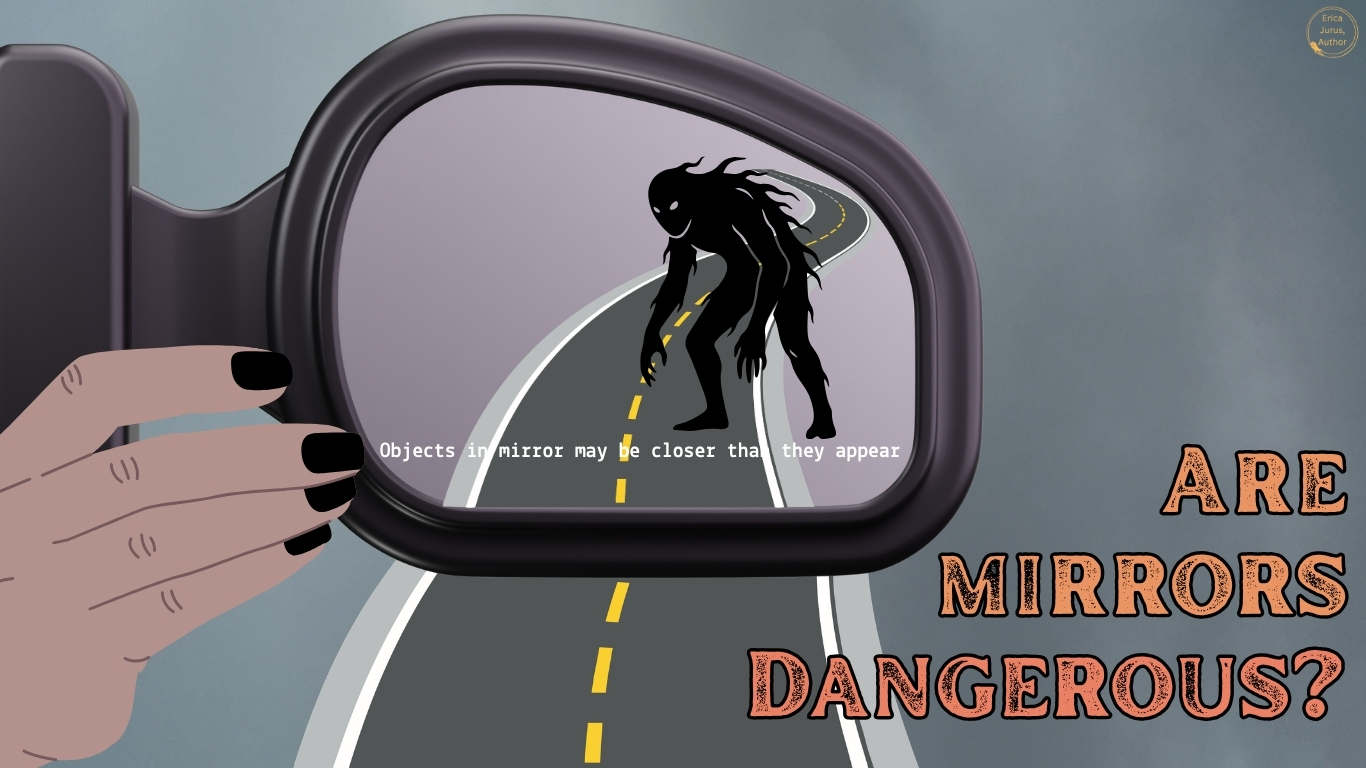
I busted a mirror and got seven years bad luck, but my lawyer thinks he can get me five. Steven Wright
Bloody Mary, Bloody Mary, Bloody…
How do you feel about mirrors? Are they annoying…weird…creepy?
We’re in the final week of Halfoween. It’s also Folk Horror Week, something celebrated on social media with lists of fave books to read and movies to watch, and the approach to two conflicting vintage celebrations: the pagan Festival of Beltane on April 30th, where bonfires are lit, offerings made for a good growing season, and fertility rituals often result in babies – contrasted with Walpurgisnacht on May 1, when bonfires are lit to drive out witches and evil spirits in honour of St. Walpurga, a missionary in the 700s who founded a monastery and was famous for her ability to repel witchcraft.
Folk Horror is a subgenre of horror that illustrates, basically, what happens when creepy small towns and ancient local legends come to a head. I grew up in a small, isolated community, and while I wasn’t aware of any occult activities, some definitely weird things went on. I assume that’s why Folk Horror resonates so well with me.
If you need samples, read Shirley Jackson’s short story The Lottery. It was a classic when I was in high school because of its power in illustrating what happens when a small town conducts an inescapable annual ritual during harvest time to ‘drive out bad omens’.

For movies, I like M. Night Shyamalan’s 2004 The Village. It focuses on a dreary 17th c. village in Pennsylvania that’s isolated from the outside world by its surrounding forest, which holds monsters. These creatures, known only as “Those We Do Not Speak Of”, will keep away from the town under certain strict rules: no one must enter the woods, or wear the colour red (a repeating theme in Shyamalan’s movies). But when a villager dies, one man decides to brave the woods to bring in supplies of medicine for another town.

There’s also a delightfully creepy episode of Murdoch Mysteries, Murdoch and the Cursed Caves, S13.E5, where Julia, William, Henry Higgins and Ruth Newsome decide to go on a ‘pleasant’ camping trip, but encounter a hostile village that talks warns them of an ancient beast stalking the surrounding woods, the Ekarenniondi, or ‘Head-Piercer’. At their campsite they find the torn tent of two murdered men, and take refuge in an old abandoned cabin, where Henry gets himself in to additional trouble by eating hallucinogenic mushrooms from the bases of some of the trees. Another great ending with a twist.
This is a great week to wrap up Halfoween with a bang!
On the theme of folk horror, a couple of weeks ago I found a wonderful decorating site with great Halloween ideas. I spent a couple of hours just browsing through the images.
Some of the bedroom-decoration designs showed how to spook-up your mirrors. Fun to look at but not, I confess, something that I’d want to do in the room where I sleep.

But it got me thinking about the pervasive concept of haunted mirrors, which are a staple in folk horror.
Interestingly, when I was at a weekend retreat a couple of years ago to take promotional photographs, during one of the discussion sessions, several attendees disclosed that they won’t look in a mirror. Ever.
It was a deeply personal subject for them, bothering them so much that they wouldn’t say why they had such an aversion.
Who doesn’t have a dark place somewhere inside him that comes out sometimes when he’s looking in a mirror? Dark and light, we are all made out of shadows like the shapes on a motion-picture screen. A lot of people think that the function of the projector is to throw light on the screen, just as the function of the story-teller is to stop fooling around and simply tell what happened, but the dark places must be there too, because without the dark places there would be no image and the figure on the screen would not exist.
MacDonald Harris (pseudonym for Donald Heiney, an author, academic, and sailor from South Pasadena, California)
But there’s actually a condition called eisoptrophobia: an ‘unhealthy fear of mirrors’. It can be caused by various factors – issues with self-image, a distaste for the way that mirrors can distort the way an object looks, or emotional trauma from a past incident. Cultural beliefs can also be part of it. Many cultures believe that the souls of deceased loved ones travel through mirrors, or get trapped in them. In these cultures, when a family is in mourning, mirrors are covered or turned away towards the wall.
I read a humorous article on Medium titled 10 Warnings About Looking into a Mirror. The writer suggested alternative reasons for avoiding mirrors, including point in your life when your mirror begins to show your parent’s face back to you, and the horror of shop mirrors that are…less than flattering.
Eisoptrophobia manifests in more than one way:
- Atelophobia: One could have a fear of imperfection, or, sadly,
- Cacophobia: a fear of ugliness. There’s also
- Chromophobia: a fear of colours. Never heard of this, but like the vampire my hubby thinks I am, I dislike very bright colours.
- Koinoniphobia: Fear of rooms. I suppose one would then avoid seeing rooms reflected.
- Obesophobia: Fear of gaining weight – don’t we all have that to some extent? 😉 (no disrespect to those who suffer from such a genuine phobia)
- Sanguivoriphobia: Fear of vampires, who, according to folklore, have no reflection in mirrors. Predicated on actually believing in them. Personally, if I suspected someone of being one, I’d want to know the truth. (And yes, I do have a reflection.)
- Thanatophobia: Fear of death. What does this have to do with mirrors? Well, there is an old superstition that young women attempting a divination ritual to see their future husband in a mirror (by walking up a flight of stairs backward in a darkened house) might instead see a skull or the face of the Grim Reaper. That would be a sign that they wouldn’t live long enough to get married.

There are so many legends about mirrors – what could be behind it? A simple piece of glass with a thin reflective layer – aluminum or silver – applied to the back. Yet suddenly the glass is transformed into a portal to other dimensions. Lewis Carroll made great use of that one for his story Through the Looking-glass. Or, if you put two mirrors facing each other, you open up a Vortex, a portal to evil spirits.
Some folklore suggests that mirrors can trap souls, usually at the moment of death. From this, the custom arose of covering mirrors after a person’s death to prevent both their soul becoming trapped inside AND to prevent a loved one’s soul from being pulled in after them. Yikes.
Mirrors are also considered “thin places” that serve as gateways between the living world and the spirit realm. In this way, they might allow demons or ghosts to enter the world of the living. Brrr.
In addition, a really creepy part of Chinese folklore suggests that our reflections are actually a separate species that mimics humans, waiting for the right moment to come out and take our places. Crap!
As if that’s not enough, the Stone Tape theory claims that ghosts and hauntings happen when traumatic events are imprinted on objects, like mirrors or even just a piece of stone, and are then replayed. Think of an earlier technology where magnetized tapes could record voices and music. Even Charles Babbage, the inventor of the rudimentary computer, believed in this possibility.
It’s also believed that intelligent entities could anchor themselves to an object that held importance for them, surviving their departure from life. Folklore also suggests that mirrors, or the spaces beside them, are places where “shadow people” live.
And we can’t forget those who use occult practices to intentionally imbue objects with negative spirits, using various evil rituals.
Mirrors are said to have evolved around 6000 BCE from seeing reflections in polished natural stone, but I imagine we were initially quite startled to see our reflections in the much clearer water of prehistoric streams.
I’m right-handed, whereas the fellow in my mirror is left-handed. I start shaving from the left; he starts from the right. Differences only in perception, but religious wars have been fought over such. Robert Breault
The earliest mirrors were manufactured in Çatalhöyük, Turkey from polished obsidian (volcanic glass. Two to three thousand years later, the Mesopotamians and Egyptians used polished copper and bronze. The first clear glass mirrors, made by applying a metal backing of lead or gold leaf, have been found from around the 1st Century AD. Eventually someone discovered that you could play with mirror properties to alter what they reflect – like convex mirrors that can cover blind spots, or funhouse mirrors that will distort your body’s shape into weird alternate forms.
It was only natural, then, that twisted horror writers began to imagine what strange things could be done with mirrors. But I return you back to par. 11, and the people who are afraid to look into an ordinary, non-haunted mirror.
Nevertheless, the lore and mythology of mirror-magic/madness is vast. There are theories that if you hang two mirrors facing each other in a darkened room, you’ll create what’s known as a “Vortex”, which can allow evil entities to come through.
Almost any mirror can serve as a portal to some types of evil, like the “Bloody Mary” legend. Bloody Mary is a phantom who may be summoned to reveal the future by saying her name three times in a mirror. Apparently a bathroom mirror produces the best results. The problem with Bloody Mary is that she may not play nice when she appears.
There’s a Mr. Hyde for every happy Jekyll face, a dark face on the other side of the mirror. The brain behind that face never heard of razors, prayers, or the logic of the universe. You turn the mirror sideways and see your face reflected with a sinister left-hand twist, half mad and half sane. Stephen King
And if you break a mirror, well… Best clothe yourself in bubble wrap for the next seven years until the bad luck you caused has dissipated.
As I was writing this post, it occurred to me that, growing up in a remote part of northern Ontario, I have enough background material to write my own Folk Horror novel some day. I think I must add that to my Magic in My Bones canon.
After all, there’s a haunted old place on the outskirts of Llithfaen that was once called Hobgoblin Farm. It’s due for a renovation…