This is not a political blog post. It’s about how countries evolve, develop problems and work them out. Authors pay attention to these things when we’re crafting the worlds our stories play out in.
I wasn’t paying a lot of attention in May, when the protests in Bolivia began – I was neck-deep in finishing the first draft of my new novel. Recently, though, protests and blockades in Bolivia’s capital city, La Paz, began to make an impression, largely because my hubby and I were there a few years ago, and once you’ve been to a place, you develop a connection.
We didn’t spend a lot of time in La Paz, only an afternoon and overnight at the tail end of a three-week adventure mainly in Peru. However, for me, one of the highlights of the trip was a visit to the ancient ruined city of Tiwanaku in Bolivia.

Tiwanaku is one of those remote places that become spell-binding because of their mystery. The citadel is high in the Andes mountains, lying on a barren, treeless golden plain over 13,000 ft up the mountains. It was ‘discovered’ in 1549 by Spanish conquistador Pedro Cieza de León while he was searching for the southern Inca capital of Qullasuyu.

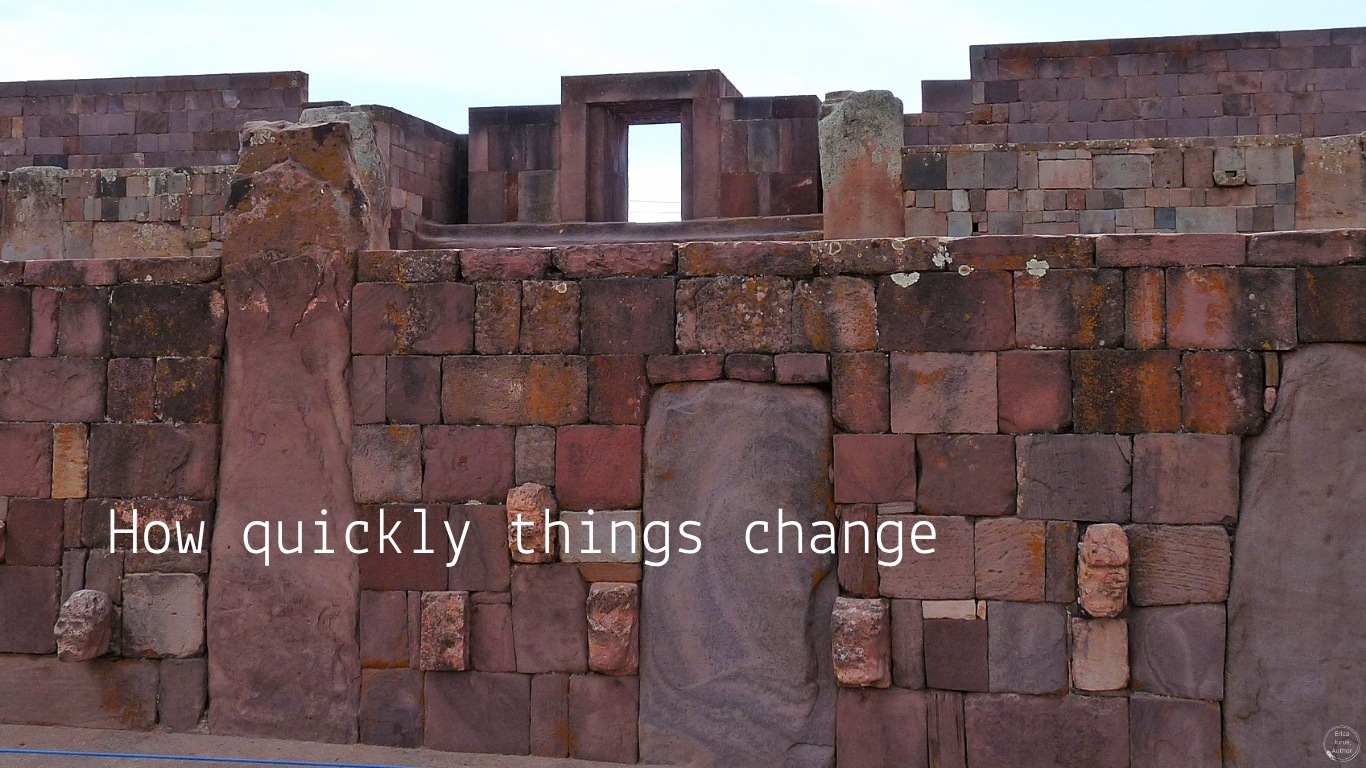
The site spreads over about 4 square kilometers of dusty brownish soil. Most of it is still being excavated, but what you can see is astounding. The first thing you see when you make the long walk from the entrance is the Akapana, a reddish step-pyramid about 840 feet long and 646 feet wide. Then you walk the length of the towering red sandstone walls of the Kalasasaya, a vast courtyard more than 300 feet long that houses the massive 13-ton megalithic Gate of the Sun. Opposite the Kalasasaya you can descend into the Semi-Subterranean Temple (hey, I didn’t make up that bland name), where the red walls of its sunken courtyard are studded with almost two hundred pale stone heads of different shapes.

A great deal of mystery and legend surround Tiwanaku. It’s believed that that the site was inhabited by 10,000 to 20,000 people in 800 AD, but early 1900s engineer and explorer Arthur Posnansky asserted that the site was 11,000–17,000 years old. A more remote section of the site, Puma Punku, is filled with such strange, and advanced, architecture that many believe it was built by aliens (Ancient Aliens: The Impossible Stone Blocks of Puma Punku, Season 9).
The plain on which Tiwanaku rests its enigmatic bones is so barren and inhospitable – at that elevation, the nights are bitterly cold, and the nearest source of water, Lake Titicaca, is ten miles away – that you immediately wonder how, or why, anyone would set up a citadel there. But the ancient peoples of Tiwanaku were master agriculturalists, growing food on raised beds that created warmer microclimates. As for why, Tiwanaku is located in a place of great spiritual importance, in the valley between two sacred mountains, Pukara and Chuqi Q’awa. Tiwanaku was the centre of the universe for the Aymara people, who are thought to be descendants of the Tiwanaku and still inhabit the area around Lake Titicaca.

You don’t see this location on many tours, and I count myself privileged to have been able to explore it myself for a short while between passing storms. Then we were off to the country’s capital, La Paz, the highest administrative capital city in the world. It sits in its own bowl amid the mountains of the Altiplano.

The city’s full name is Nuestra Señora de La Paz (meaning Our Lady of Peace). It was founded in 1548, by the Spanish conquistador Captain Alonso de Mendoza, and is now the seat of the Bolivian government, as well as an important South American cultural centre. All of the city is at such a high altitude – ranging from 11,975 ft to 13,000 ft – that all the hotel rooms serve coca leaf tea in the lobby. That’s the plant that cocaine is derived from, and it’s present in the leaves when steeped or chewed. In such a mild form, the natural stimulant helps tourist bodies adapt to wandering around in the thinner air.

As I mentioned, we weren’t able to see much of the city at all, but it bustled along with its usual rhythms. In May, however, ongoing mass protests began in La Paz.
Bolivia is in the middle of an economic crisis, apparently the worst the country’s had in decades. Protests had started intermittently back in January, but erupted at news of a new land mortgage law, which was feared to allow businesses to buy land out from under farmers. Even though Paz annulled the law on May 13th, the protests haven’t abated.

Protesters began by setting off explosives and clash with police around the presidential palace. They’re calling for the resignation of President Rodrigo Paz. There have been escalating blockades that are keeping essential goods out of the city. Within a week, four people had been killed; the total is now up to ten.
Bolivian miners have jumped into the fray, protesting for labour reform and fuel, and have been joined by teachers and Indigenous Bolivians. On May 26th, the Bolivian Congress passed a law allowing Paz to deploy the Bolivian Army against the civil unrest. According to the Ombudsman’s Office, the country is on the “edge of the precipice”. Protesters have numbered in the tens of thousands.

According to one article I’ve read, it will be four million rural Quechua-Aymara in the highlands and valleys, and their allies in the trade unions, who’ll ultimately transform the unrest. On June 3rd, they announced that they’ll march on La Paz to remove the President. Paz has tried to negotiate with the protesters and tried to avoid severe clashes by the police force. But demonstrators are refusing to back down. To date, I haven’t seen any news of the big march; we’ll see what happens and where this all leads.
My hubby and I were only there long enough to see the surface of the country’s economy and culture. All I can say is that La Paz was peaceful at the time and felt like a place we’d like to revisit. I hope the Bolivia we saw, with such amazing history and culture, can recover without further violence. Tiwanaku alone fascinated me so much that I included it in my Chaos Roads trilogy.
But I’ll admit to watching this play out with an author’s viewpoint, like a drone hovering over the whole thing, and making notes that I plan to use in an upcoming novel. It’s a way to bring more authenticity to the burgeoning war I’ll be describing on a planet far, far away. Can my war be avoided? We’ll have to see. I certainly hope Bolivia manages it.