I wrote my first novel during the COVID lockdown and experienced the surreal situation of getting vaccinated in a crowded arena, all while staying home to avoid infection and worrying about a friend’s son who was critically ill, as well as waiting in long lines for groceries.
How did that happen to our world? Landing in the middle of the pages of a sci-fi novel or the plot of a sci-fi movie? A 21st century problem: diseases that could spread across the globe like wildfire.
Growing up in the 20th century, when we could read whatever we wanted, I never envisioned that the freedom to read would become another 21st century problem. That we would once again step into the pages of a sci-fi novel.
Ray Bradbury is often quoted lately from discussions about Fahrenheit 451, his famous novel about a future dystopian America where books have been outlawed and “firemen” burn not just any books that are found, but the houses of the owners:
“You don’t have to burn books to destroy a culture. Just get people to stop reading them.”
Growing up, he’d been horrified by real-life examples – in particular the Nazi book burnings, destroying all books viewed as being subversive or as representing ideologies opposed to the ideology, and the Great Purge in Russia, in which many scientists, mathematicians, theatre directors, writers and others (in other words, people of ideas) were arrested and executed.
Bradbury wasn’t just commenting about the censorship of ideas; he also referred to how mass media reduces interest in reading literature.
And here we are, in a society so far advanced beyond my youth, and his, and anyone born in the 20th century, that his speculations have become fact.
But people are fighting back. We haven’t completely entered the new Dark Ages, as Times columnist James Marriott calls it in his new book, The New Dark Ages: The End of Reading and the Dawn of a Post-Literate Society, yet.
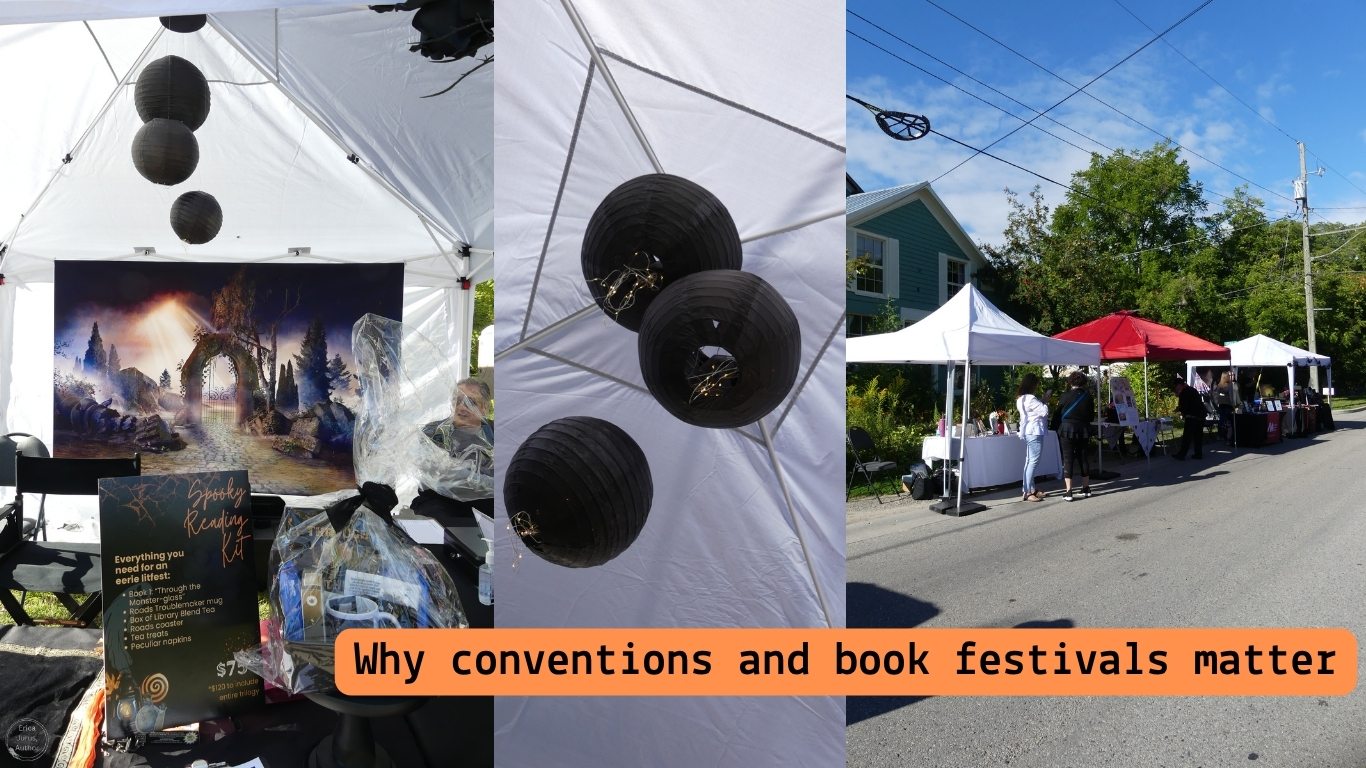
As an author, I see a lot of positive signs out there, just from the conventions and conferences I attend.
At every single book signing I did last year, both adults and children stopped to talk to me about writing books, with their own passion for the idea of maybe one day writing their own. And even if the convention wasn’t specifically literary, people bought books – not just from me, but from the many other authors on site.
I’m encouraged when cosplayers dress up in literary costumes.
I was, frankly, astonished and delighted at how many passionate fans of H.P. Lovecraft travelled from within North America and abroad to attend the Necronomicon festival in August. Fans who love the stories, the ‘weird’ fiction that Lovecraft more-or-less pioneered, the sheer inventiveness and wildness of his concepts.
I’m invigorated by the explosion of non-traditional literary genres. Romantasy, for example, has become exceptionally popular, followed by horrormance, cozy horror (yes, there is such a thing), and just about any crossover type of plot that you can think of.
There are so many literary conventions just in my own province of Ontario that I can’t keep up with them! They’re showing up in cities small and large, in convention centres, hotel ballrooms, even coffee shops. And the organizers of them are spreading events into other provinces. Pages & Pleasures, a romance convention that I’m taking part in on December 5th in Hamilton, is expanding to Halifax, Nova Scotia next year, and to judge by the enthusiasm on the event’s Facebook page, will be a huge success.
Strangeness breeds in isolated communities; that’s why it’s such a beloved subject for horror novelists. (Ooh, that gives me an idea 😉)
I spent a couple of years in one in northern Ontario when I was a child, and let me tell you – it wasn’t as bad as the movie Deliverance, but… Let’s see, someone from a neighbouring almost killed me when he was trying to poach a pheasant off our farm. I was playing in the yard, and I remember the bullet whizzing by my head. My dad leapt into the truck and gave chase, but couldn’t catch the f*nut. And at the farm one over, both the mother and the 14-year-old daughter were both sleeping with the travelling salesman.
When there’s no influx of fresh ideas, people turn inward. We had some lovely people in the community, don’t get me wrong, but others were living in tar-paper shacks in the woods, talking to their jugs of hooch (not an exaggeration).
One of the first things my hubby and I learned when we began travelling is that people in other countries are just like us. They want the same things: a good job, love, a home, feeding their family. It’s the people in the governments who place their own agenda above their constituent’s wellness, and extremists with rigid ideas, that create havoc.
Many, many studies have shown that reading is critical to mental health, the prevention of dementia, and general well-being. According to Cambridge University,
“Survey data in adults suggested that reading was associated with reduced stress, greater empathy, enhanced well-being, and decreased loneliness…cognitively stimulating activities, particularly reading, are associated with a lower risk of dementia and slower cognitive decline…” And, “In childhood and adolescence, early reading for pleasure has been linked to better attention, memory, executive function, academic achievement, and fewer mental health problems.”
Community and freedom of expression make a difference. Earlier this year, Amazon had announced the plan to revive beloved sci-fi series Stargate SG-1 – then scuttled it. Fans started a petition on Change.org, #SaveStargate, to save the show. I just read that the campaign has now had more than 120,000 signatures, many of them spurred at DragonCon in Atlanta. Amazon had claimed that the revival was too ‘niche’, but the interest shown by the thousands of signatures belies that. And ‘niche’ shows have massive audiences. Fingers crossed for this petition to succeed; it’s still available to sign.
I decided to change this week’s blog post in response to all the bad literary news, from surveys showing how much reading has declined, especially in young people who have their faces buried in electronic screens, to reports from the U.S. that booksellers may be convicted on terrorism charges if they don’t remove certain books from their shelves. The reports coming in for existing arrests are horrifying – convictions of up to 50 years in prison already.
But my experience with meeting readers has been very uplifting. I hope that’s not unique to Canadian authors.
Back in the summer I read a great article about the keynote speech at the 2026 London Book Fair. I’m including a brief excerpt because I couldn’t put it any better :
“Festivals are where books meet readers. Where stories step off the page and into conversation. Where writers and audiences encounter each other directly—not through algorithms, but through dialogue.
And those audiences matter enormously. Because a book without a reader is only half alive. Readers complete the story. They recommend books to friends. They debate them. They challenge them. And they turn private reading into shared cultural life.
When readers gather at festivals, something powerful happens. Reading stops being a solitary act. And becomes a collective one. A book becomes part of a conversation. And that conversation has real impact.”
Reading = ideas i= freedom. It’s essential to the survival of Culture.
I’ve tried not to be overly political on my blog because I like to write for entertainment, but it’s becoming impossible to avoid. We all have to stand up for freedom of speech, and all it represents: an acceptance of the right to ideas, even if we disagree or don’t particularly like what someone else is saying. And that must apply on all sides of an idea.
I think the majority understand that, and if we all stand up for it, we’ll win.