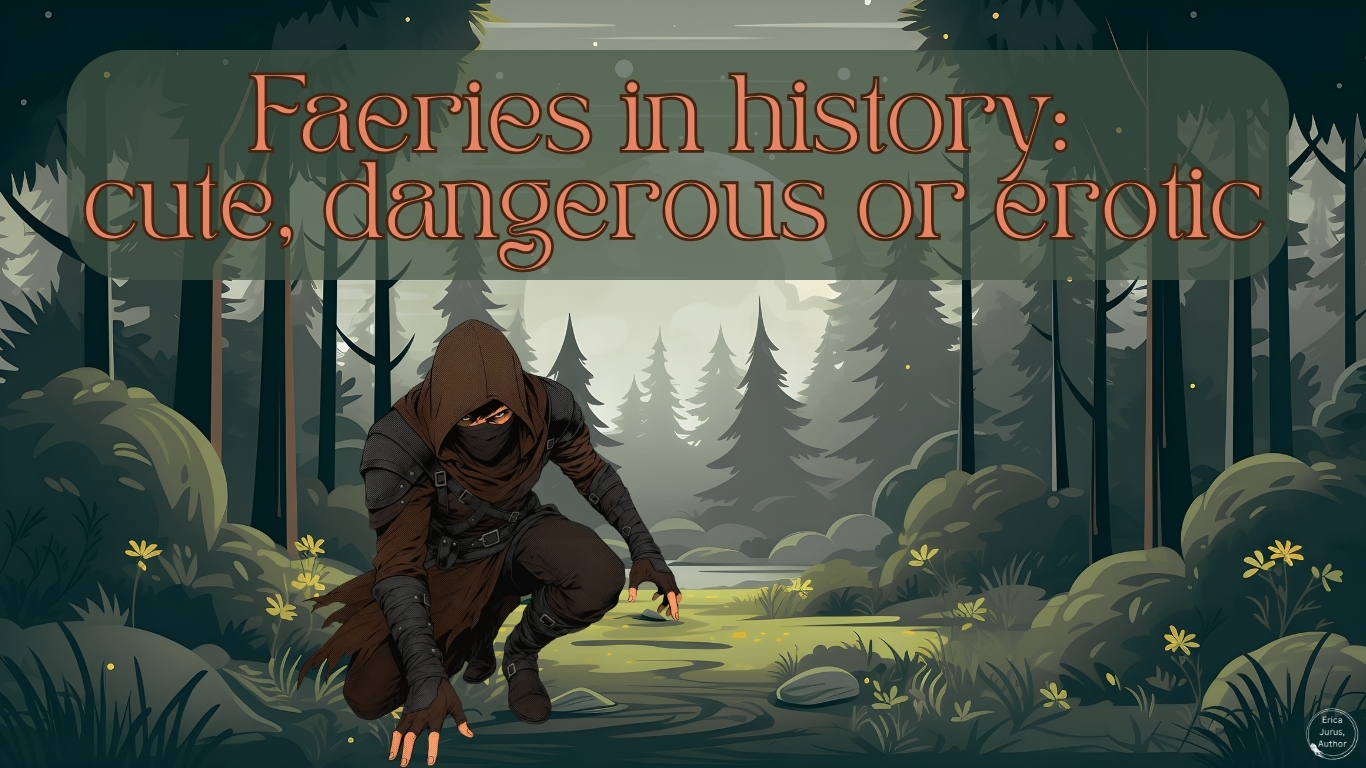
If you lived in medieval times, you were constantly trying to ward off all the evil that fairies, magical beings who lurked in the woods, could foist upon you.
Legends portrayed them as looking human, with a decided bent for trickery. They might be any size from tiny to our own height, possibly with wings. Some, like the will-o’-the-wisps, appeared as nebulous ghost lights that would lure you to your death in a swamp – such dancing lights are reported all the time across Asia, Europe, Great Britain, and both North and South America.
It was essential to ward off fairies with protective charms – church bells, food, four-leaf clovers, and for some reason even wearing one’s clothing inside out.
In one of my favourite Halloween reads, Tanya Huff’s Summon the Keeper, Claire, the Keeper of magical balance in the universe, handed out fairy buns on Halloween night to help the young innkeeper of the hotel she’s guarding keep out of the clutches of any approaching fairies drawn to the cursed hotel. One of the fairies, the Leanan Shee, was a nasty creature, indeed – enchantingly beautiful at first sight, but her real appearance included a ravenous set of teeth.
In the Victorian era fairies transformed into the cutesy little winged creatures flitting around gardens – the same that took Great Britain by storm during the great fairy hoax that swept up Sir Arthur Conan Doyle and many others.
Going back to medieval times, there was a long tradition of fairy women or men seducing humans, generally at great cost to the human lovers. In Nordic lore, the skogsrå (a forest spirit) appeared in the woods as a beautiful and seductive woman, although if you took a better look you’d see her cow hooves. But even worse than that potential bestiality, anyone who had sex with her would die within a year. Yikes.
One of the most famous fairy stories, from an old 1500s Scottish ballad, is the story of Tam Lin. In it, a woman named Janet plucks a rose in the forest of Carterhaugh and is finds a handsome young man named Tam Lin, who gets her pregnant. When she realizes her condition, she seeks him out, and he tells her he’s being held captive by the Fairy Queen. Janet can win him back if she follows his instructions, which are to hang on to him for dear life as the fairies magically transform him into various forms, and his final form is a naked man.
In another great urban fantasy tale, from the 1990s, author Pamela Dean set a modern version of the Tam Lin tale at a Midwestern college in the 1970s, where Janet is a student who falls in love with a fellow student named Thomas Lane. But he’s caught up in a study group led by the Fae Queen herself, and Janet must do everything she can to save him from being dragged off to the Fae lands.
Romantasy queen Sarah J Maas took inspiration from the Tam Lin story herself, in her stupendously popular A Court of Thorns and Roses series of romantasy novels. I even put a version of Tam Lin in my Chaos Roads trilogy, and he makes another, darker appearance in my newest novel, The Summer Door, a horrormance where happy endings are in short shrift. (Currently available in printed copy only; I’ll be loading the ebook version in a couple of days.)
There’s debate over what exactly fairies are. Some think they’re fallen angels, or some form of demi-gods. In Celtic lore, they are the Tuatha dé Danaan, a race of beings who dwell in the Otherworld. They are kings, queens, bards, warriors and heroes, healers and craftsmen who have supernatural powers. Medieval texts about them, written by Christians, explained the Tuath dé either as fallen angels or ancient people who became highly skilled in magic. It was said that during the angelic revolt (led by Lucifer), God ordered the gates of Heaven to be closed. The angels who were still in heaven remained angels, those in hell of course became demons, but those caught in between those two planes became fairies. Others speculated that, through some grading system, some angels, who were neither godly enough or evil enough, were thrown out of heaven to become fairies.
William Shakespeare wrote the fairies as mischievously interacting with humans, and on occasion cruelly. In A Midsummer Night’s Dream, Titania, the queen of the fairies, falls for a weaver called Bottom who had his head changed to that of a donkey by Puck, the Fairy King’s lieutenant, and many productions of the play lean into the eroticism of the story.
Even JM Barrie’s creation Tinker Bell, from Peter Pan, may look cute, but she is capricious, alternately cruel and kind – and jealous of Wendy, who’s falling in love with Peter.
I’m fascinated by the concept of magical beings that cross over from their world to ours, and becoming so pervasive in human culture that people have spent centuries trying to figure out their origins. Somewhere, someone began interacting with a creature they felt compelled to categorize as a fairy. It’s said that all legends must have some basis in fact. So what really happened way back in the mists of time?
The breadth of form and temperament in legends of Fae has become the perfect medium for stories about humans getting involved with them, with all the inherent danger – and possibly sex (for the adults among us).
Most contemporary authors refer to fairies as “Fae” – to my mind, because it sounds ‘adult’ rather than petite and ‘cutesy’. The word Fae comes from the Old French faerie, derived from fae (fay), which itself derives from the Latin fata, meaning “fate”. In most stories, the Fae determine the fates of the humans they choose to toy with.
In all stories, the faeries are intensely fascinated with humans, often as lovers, usually as victims of deceit and trickery. In some of the older tales, faeries might be helpful, as with the elves who helped the shoemaker, but that’s been a rare occurrence.
The Fae can take many forms, not all of them pleasant. My favourite contemporary series involving very dangerous Fae was written by Karen Marie Moning. I edged into her Fae Fever series with some skepticism – initially, the concept of a woman who travels to Ireland and discovers a special ability seemed a little trite – but the plot plays out beautifully as MacKayla Lane, initially an apparently bubble-headed young woman in Georgia, goes to Dublin to try and find out why her beloved older sister was murdered while studying at the university. Things go sideways very quickly as Mac stumbles into the world of the Fae, who walk unnoticed among humans – except for a few rare people like her, who can see them, putting her in grave peril.
For me Moning defined the idea of sexy, dangerous and even monstrous Fae, and the crossover world she created is unparalleled as, throughout the series, more and more of Dublin becomes a literal dead zone that the citizens forget ever existed.
In my original trilogy, readers have seen a little of the Fae in my Chaos Roads trilogy – just Manannan, the sexy and manipulative king of the Fae, and Rachel, a Fae who grew tired of all the machinations in her own world and has chosen to live in the human realm to operate a bakery. In my new horror novel, The Summer Door, launching in October, my protagonist Stephanie is seduced by power and sex into the very dark Fae realm, where there are gorgeous Fae, arrogant Fae, treacherous Fae, sorceresses, horrendous monsters and all manner of other strangeness. She becomes embroiled in a power struggle that she’s not at all certain of surviving.
Stephanie’s tribulations are part of a larger arc, to be continued in the rest of my new Magic in My Bones series. Her journey is a dark one indeed, as she feels the full force of Fae persuasion and manipulation. I’m very excited to put her story out into the world, and I hope you find it as fascinating as I did writing it. (Please note the trigger warning at the start of the book.)